May 31, 2026

Nepal is known as the land of various ethnicities, from the plains of Tarai to the height of the Himalayan range. All ethnic groups have their own culture and tradition. The Tharu is one of the most popular indigenous peoples in Nepal and India. Tharus are one of the major indigenous communities of Nepal, who mostly inhabit the Tarai region extending from Jhapa district in the East to Kanchanpur in the West, as well as inner-madhes, namely Udaypur, Kamala Khoch, Chitawan, Dang, and Surkhet, now collectively referred to as Tharuhat. The Tharus have a rich cultural heritage. They speak their native language, which originated from Sanskrit and is very close to Maithili; however, as one travels from one end of the terai plains to the next, there are considerable differences in the variety of the Tharu language spoken locally. Similarly, it is observed that the arts & crafts of Dangoriya Tharu ( in the western terai plain) are different from the arts and crafts of Morangiya Tharu (in the eastern terai plain). Their distinct arts & crafts are integral parts of the daily life of the Tharu society. In fact, Tharu are most clearly distinguished by their art and culture. Some of their typical arts & crafts can be seen in the design of the tools they use, such as agricultural tools and household items, as well as in their paintings and drawings. Both males and females are involved in preparing such arts & crafts. Tharu make and use arts & crafts in their daily life for various purposes. However, the same arts & crafts are named differently in different areas of settlement across the plain and in the inner-Madhesh. There are some arts craftwork which are typical and not found among other Tharus except the Morangiya Tharu. The typical arts & crafts of Morgangia Tharus include Mokha arts, Achara, korha, Kaur, chulha, and so on. They have developed a typical style of painting the outer walls and verandas of their homes in colorful forms depicting Laxmi, the Hindu goddess of prosperity and fertility; such paintings are done in preparation for Dipawali, the festival of light.
According to Kurt W. Mever and Pamela Deuel, as given in their book “The Tharu of the Tarai”, the most striking aspect of the Tharu environment is the decorated walls, partitions, and rice containers of the houses.
For generations, Kochila Tharu women of the eastern Tarai have transformed the verandahs and outer walls of their homes into colorful outdoor canvases dedicated to Laxshmi, the Hindu goddess of prosperity and fertility, at Tihar, the festival of lights. The third day of Tihar is devoted to worshipping Laxshmi. According to the Tharu legend, on this night, she circles the earth on the back of an owl, inspecting homes to see that they are properly purified with rigorous cleaning and have newly painted walls. At twilight, the villagers burn small oil clay lamps to attract her attention to their houses, fields, and farmyards so that the Goddess will grant the family prosperity throughout the coming year. She visits each house.
According to the same authors, while some of the patterns on these houses are simply decorative, others contain auspicious elements. Important in South Asian mythology, the peacock adorns more painted houses than do any other birds. Sanskrit literature associates it with human happiness, passion, and bliss: Ram and Sita delighted in the company of peacocks, and when Sita was abandoned by Ram, it is said that the peacocks ceased to dance. Many Tharus believe that if they spot a peacock when they first step out of their home, they will be favored with good luck that day.
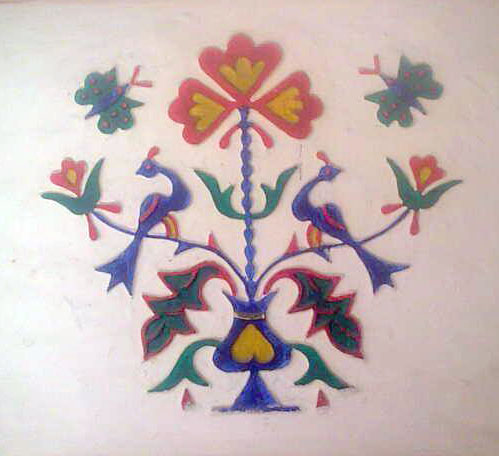
According to Pramila Gachhadar in her work “Tharu women and their Art and crafts,” Tharus are fond of beauty, which can be reflected in several ways, one of them being the designs and decoration on the walls of their houses. Tharu houses are decorated by their womenfolk who make beautiful paintings, mouldings in relief, engravings, etc., on them. Especially before ceremonies, festivals, or in special functions, they try to make the house look good by recolouring the paintings already made or by making new ones if necessary. But it was found that the Morangiya Tharu houses are decorated with beautiful mokhaa and mokha arts. The walls of houses are of mud. When dry, the wall is smeared with pond clay mixed in water (laththa maati). The wall is smeared with different types of mud locally called ‘laal maati’, ‘ujra maati’. This gives the walls a beautiful white or brick -red colour. Today, different kinds of chemical colours are easily available in the market and can be used for this purpose. Various colors are used for paintings and designing, like black, red, green, white, yellow, etc. Some more colors are acquired by mixing more than two colors to increase the glaze and for attraction. There is no hard and fast rule for the application of colors. But mostly they try to match the colors of nature. For example, flowers painted red, yellow, pink, etc., and leaves painted green. But some painters use other colors too in the leaf, so it depends on the personal interest and preference of the artist.
Some arts & crafts of the Tharu used for decorative purpose are described as follows: Mokhaa art is a popular, endemic art of the Tharu community. Tharu women perform their traditional, cultural, and spiritual expression through mokhaa art over the walls, especially on the two sides of the door. After composing the hand art using clay soil, they again add various suitable colors. Even the components of the local environment, like plants and birds, can be seen over these mokhaa arts. Well-decorated house displaying mokhaa art is still known as a house with lucky women. There is prosperity in a house having mokhaa. According to popular belief among the Tharus, if there is no mokhaa in someone’s house, half a kg of rice is lost every day. From the two sides of mokhaa, various designs of flowers (latpat) are made locally, called mokha. Besides flowers, different birds (like peacock, parrot, etc.) & animals such as elephants horse etc are also made with mud, a special type of mud which has elasticity called latthaa maati. After shaping the mokha, they are colored to give the finishing touch. Mokha is also made around the windows and over the wall. One week to one month time is taken for making these mokha, depending upon the size and designs of the mokha . The main materials required for making mokha and mokhaa are water, milk of cow or goat, jute fibres, and clay. No special training is given to Tharu women and girls; rather, they get knowledge of it from their parents and society. Chakka. it is made from clay; especially women are involved in making this Chakka. Chakka is constructed in the inner and outer walls of the house. Generally, it is made in a straight line of door, for show as well to put things. Chakka can be made in various artistc shape and sizes. Korha, painted with lal maati and ujra maati on the wall of Osra. Khutta: A pillar of wood, a corridor of the home, which is plastered with mud in various designs. Various colours are applied for making various designs like plants, flowers, animals like elephants, peacock, tree, birds, leaves, etc. on the wall facing towards the street.”
Referring to the work of Suman, the author of this article, Abhi Subedi, says,” he has used the relief of Tharu and Mithila art. …For example, the wall paintings of the Tharu people are treated with a naturalness that is simple and poetic.” In my exhibitions, I have incorporated the images from Dhushadh, Jhanger, Dhimal, Santhal, Satar, and Tharu indigenous communities' artwork of the “Bhitti-chitra” or “Mokha” (doorstep) paintings that adorn the façade of a Tharu home with decorative elements around the doorstep and windows also find expression in my series.
– Published in Lalitkala Patrika (Magazine), April 2015, and S.C. Suman's Website
SC Suman is a self taught artist who watched his grandmother make ritual paintings in the Mithila tradition. He is a textile designer by profession and also is a celebrated radio host in Biratnagar. He has held 14 solo shows in Nepal, France, Japan, Australia and the Netherlands. He has won many awards including the Rastra Pratibha Puraskar. Suman has been served as a Council Member and Head of Department of the Folk Arts (2071-2075 B.S.)at Nepal Academy of Fine Arts. Das has been actively working in various organizations for the development of art and artists for more than 20 years. He has served as a “Chief Judge” for several different art competitions. Das organized the National level Art Workshops in Biratnagar in 2002-2015. He is currently researching Mithila, Tharu, Santhal, Dhimal, Folk Art & Culture, which is facilitated by Chetena Sanrakshan Pratisthan, Nepal.
The caste system in Nepal remains as an integral aspect of societal structure which dictates the authority, status and economic framework.
Sun Aug 09 2026
Jitiya is the most valuable festival of the Tharu women which is celebrated by mothers by fasting for their sons' wellbeing.
Sun Aug 09 2026
The Newly elected Mayors and Deputy Mayors of all the 7 Provinces of Nepal. Local election was held on 13 May 2022 (Baisakh 30, 2079)
Sun Aug 09 2026
Janai Purnima is an important day for Dhami-Jhakri (Traditional Healers and Shamans) of Nepal to boost and renew their spiritual power.
Sun Aug 09 2026
Oct 13, 2022
Jul 18, 2023
Sep 20, 2023
Jun 2, 2022


Ask Me About Nepal (AMAN) is your go-to digital platform for authentic, well-researched insights into Nepal’s people, places, culture, and hidden gems. From adventure to history, food to folklore—explore Nepal like never before!


Help us document the beauty and stories of Nepal. Your donation powers AMAN's journey.

Get captivating travel stories, hidden gems, and cultural insights from Nepal delivered to your inbox every month!
Want to Become a Contributor? Click Here
© 2025 Ask Me About Nepal. All Rights Reserved.