July 18, 2023

Malamas, formerly known as Adhikmas, is technically an extra month that occurs every three years, falling between the months of February and October. According to astrology, the Solar calendar has 365 days, 15 hours, 31 times and 30 cyclones, and the Lunar one has 354 days, 22 hour, 1 time and 23 cyclones in a year. T
he Moon and the Sun do not have travel in the same motion; one moves faster than the other, creating a difference of 10 days yearly. To accommodate this difference of thirty days in three years, a month of Malamas occurs. This is also a month when there is no solar eclipse. The months and years depend on the motion of the Sun and the Moon. According to the constellation, the solar month moves according to the speed of the sun and is of 30 days long, while the lunar month moves according to the speed of the moon made of 27 days long.
According to the Hindu Mythology, all the zodiac signs, constellations, months, etc, each had their Guru, but Adhikmaas and he were condemned for the Guru’s absence in his life and termed as Malamas. Saddened by the condemnation, Adhikmas sought refuge with Lord Vishnu and shared his sorrow. Learning about his sorrow, Lord Vishnu in the form of Krishna made him his disciple and bestowed him with the name Purushottammas. Purushottam, the Supreme Being, is one of Krishna’s many names. Now that with Krishna’s blessing, Adhikmas is known as Purushottammas, people are encouraged to perform meditation and donation throughout, because all the good deeds done during this phase garner merit for themselves and their family.
However, the auspicious rituals like Marriage, Shraddha, visiting temples, and organizing pujas are avoided in this month. Also, newly married couples suffer separation in Malamas, because consummation and conceiving offspring during this period is prohibited due to its inauspiciousness.

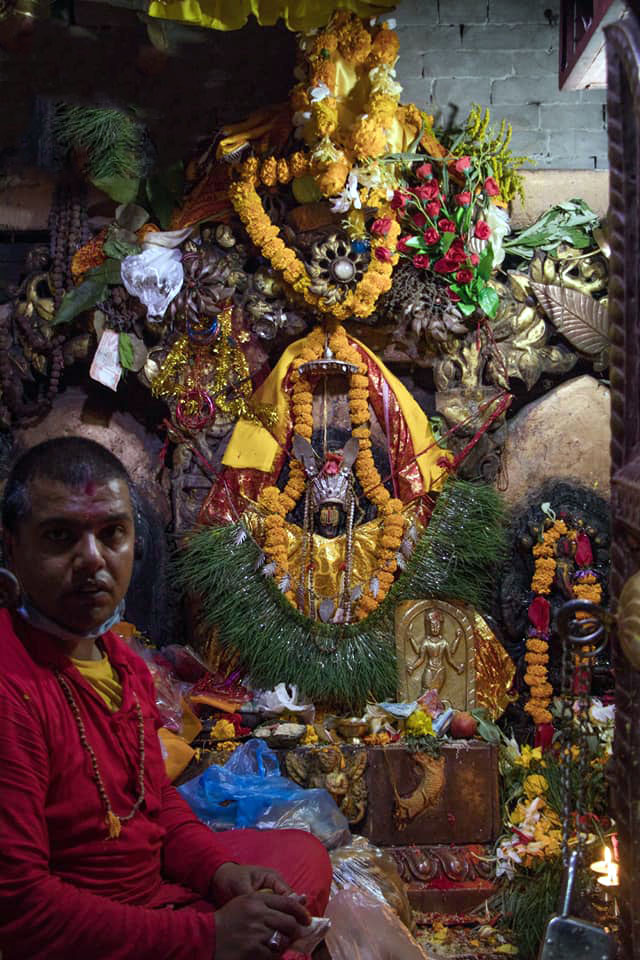
The temple has an artistic entrance of a gold-plated Garuda, Bishnu’s stride. Machhenarayan, as his name suggests, is a four-foot-tall statue with the upper torso as human and the lower as a fish depiction of Bishnu. He is represented with four hands, holding Sankha (the conch shell), Chakra (the discus), Gadha (the club), and Padma (the lotus).
Machhenarayan also spelt as Matsyanarayan, like in Sanskrit, is the first of ten incarnations of Vishnu on Earth. Vishnu, in the form of Matsya (fish), saved the world from Shiva's great flood. Moreover, he had to save Manu and his wife Shatarupa, who, according to the Matsya Purana, were the first couple on Earth that would be instrumental in conceiving humans after Pralaya. Pralaya is the process of destruction of the universe that takes place at the end of each kalpa (age) and precedes a new creation.
A little fish swam into the hands of Manu (aka Satyavrata, the king of pre-ancient Dravida) while he was washing his hands inthe a river. It pleaded to save its life. Manu put the fish in a vessel, which it outgrew in seconds. He then moved it to a tank, a river, and then finally to an ocean, but to no avail. When Manu realized that it was no ordinary fish, it revealed itself to be Vishnu in the form of Macchenarayan. It warned him about a deluge that Shiva was planning for in the next seven days. The flood would take over the earth until everything was a single ocean. And the mare living at the bottom of the ocean would release a poisonous fire that would burn the whole universe. Therefore, Macchenarayan instructed Manu to build an ark to save all medicinal herbs, varieties of seeds, Sapta Rishi (seven saints), Vasuki the serpent, and every animal.
When the flood hit, Manu saved himself and all the living beings by tying his ark to the horn of the fish’s head which drove the ark to the Himalayas, where the human civilization began. Manu used the Vasuki serpent as a rope to tie the ark to the fish's head (the fish-savior was referred to as Prajapati). Thus, the story of Machhenarayan proclaims the protection and sanitation of all creatures, including fish living in the water and the reservoir itself.
Previously Published on September 20, 2020.
Content Creator and founder or Ask Me About Nepal
Gujeshwari mandir perched above the hill is hidden behind the wall or even houses. It is the most beautiful temple, one of the all-time masterpieces of Hindu Surrealism on top of that its one of 51 Shakti Pithas (holy place of cosmic power)
Sun Aug 09 2026
A polished black stone idol with 18 arms. Bedecked with silver ornaments. Drenched in vermillion. The Goddess Bhagwati holds Astra/Nastra (weaponry and symbols) Patra (vessel), Trishul (trident), Kulhadi (Axe), Damaru (two headed-drum), Chakra (disc), Gadha (mace), Khunda(scimitar), Matsya (Fish), and Ghanta (bell) on her hands.
Sun Aug 09 2026
how Pinecones come in handy in Nepali households and its contribution to forest ecosystem of hilly areas in Nepal
Sun Aug 09 2026
Yeti's Skull and hand bone remains are in display at Pangboche Monastery in Solu Khumbu District for many years.
Sun Aug 09 2026
Oct 13, 2022
Jul 18, 2023
Sep 20, 2023
Jun 2, 2022


Ask Me About Nepal (AMAN) is your go-to digital platform for authentic, well-researched insights into Nepal’s people, places, culture, and hidden gems. From adventure to history, food to folklore—explore Nepal like never before!


Help us document the beauty and stories of Nepal. Your donation powers AMAN's journey.

Get captivating travel stories, hidden gems, and cultural insights from Nepal delivered to your inbox every month!
Want to Become a Contributor? Click Here
© 2025 Ask Me About Nepal. All Rights Reserved.