November 19, 2023

Ekadashi, the number 11 in Sanskrit denotes the 11th day of a bright or dark fortnight i.e Sukla Paksha and Krishna Paksha, respectively. Ekadashi is the day for the Hindus to fast in the name of Lord Vishnu. On this day, people observing fast do not eat grains, beans, or rice, and some devotees go as far as strict fasting, i.e., without a drop of water. But that is not a rule for everyone to follow a strict fast. It differs from person to person and depends on how far one can test the limit. So, those who are unable to fast hard, they can eat light but avoid rice and grain items. People fast on Ekadashi for peace of mind, and doing so also has a scientific significance. According to Sadguru (an Indian yogi and author), fasting cleanses the impurities from our body. So, it’s good to have an empty stomach often (at least once a week) and not necessarily in the name of God. For example, intermittent fasting these days is a common mode of getting healthier. Still, without giving much a glance toward the scientific facts, the Ekadashi fast should be accepted either by hard means or the light means. On the day of Ekadashi, devotees should spend more time chanting the bhajans (devotional songs) and visiting the temple.
Within these two regular Ekadashis of every month, there are two major Ekadashis called ‘Thuli Ekadashi’; Harishayani Ekadashi, and Haribodhini Ekadashi in order. Both Ekadashis cover the time of the first and the last Chaturmas day. It is considered a holy period to worship Lord Vishnu. Hindus celebrate both these Thuli Ekadashis with great respect and joy by fasting and offering bountiful worship and prayers to Vishnu. However, one Thuli Ekadashi slightly differs from the other.
Chaturmas, literally a period of four months, is the time between Asadh Sukla Paksha Dwadashi (12th day of the bright fortnight (waxing moon) in the Hindu month of Ashadh) and Kartik Dashami (the tenth day (Dashami) of the bright fortnight (Shukla Paksha) in the Hindu month of Kartik). During these four months, Lord Vishnu takes a long sleep. No auspicious events like Marriages, Bratabandhan etc must take place throughout this time because during Chaturmas any auspicious functions performed will be ignored by the supreme soul and won't garner any good fala (fruit of deed). Therefore, people only get to their own work, whatever field they belong to, with full devotion rather than organizing any auspicious functions. Although any felicitous functions are forbidden during Chaturmas, there still falls a few important events like fasts of Shravan, Ganesh Chaturthi, Haritalika Teej, Rishi Panchami, Naag Panchami, Nauratha, Kojagrat Purnima, Govardhan Puja, etc., are the major fasts of Chaturmasa (the time of Lord Vishnu's slumber). Observing the Chaturmas Brata (fasting) is regarded as an auspicious act that follows the ritual of Tulasi planting on Harisayani Ekadashi and is concluded with its marriage ceremony on the Haribodhani Ekadashi.
Harishayani is made up of two words: 'Hari' and 'Sayani', where 'Hari' means Lord Vishnu and 'shayani' means sleeping. Therefore, Harishayani Ekadasi denotes the day when Lord Vishnu goes to sleep for a long time. He sleeps from Ashad Sukla Ekadasi in the Chhir Sagar (an ocean of milk) on his bed of Sheshnag (serpents). The Vedas and Puranas explain that God has special days for human welfare. Therefore, we are advised to regard the exceptional days as the days devoted to worship.
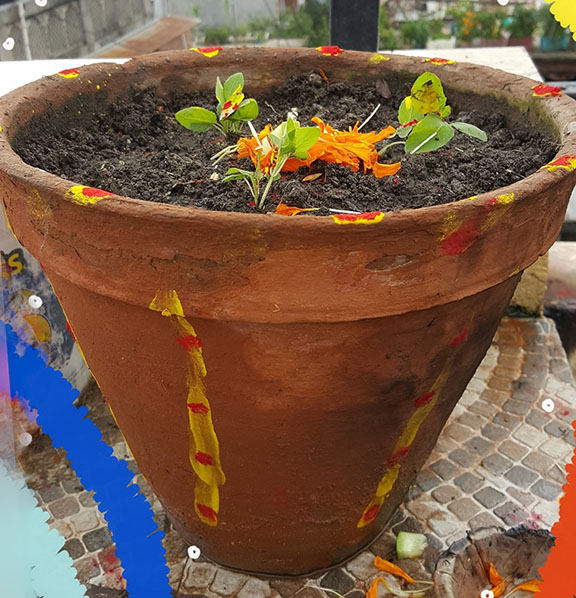
On the day of Harishayani Ekadashi i.e the first day of Chaturmas, Hindus plant Tulasi, the Holy Basil (Ocimum tenuiflorum), in their yards in math, a pot-like masonry structure, or just regular mud vases. Veneration of Lord Vishnu takes place by bathing his Idol in Panchamrita (aggregation of five elements: milk, honey, curd, molasses, and ghee) and water dripped from a conch shell. Then, some fresh flower garland and jewellery should be offered, and then Tulasi (Ocimum tenuiflorum) is planted. The fastings of the day don't end here, it lasts until the evening. The devotees should not consume any food for as far as possible. Extreme fast is expected on the day, but people may eat fruits under medical conditions, but avoid grains and rice. In the evening, after the worship of Tulasi and lighting Diyo (oil lamp), the devotees can break their fast with some fruits and milk. People worship the Tulasi as a Laxmi Sworup (manifestation of Goddess Laxmi), Vishnu's consort, throughout Chaturmas until Haribodhini Ekadasi. The newly planted Tulasi is given tender hands to nurture, providing it with a little water and timely manure. Devotees must venerate Lord Vishnu on all the Ekadashis that fall during the Chaturmas once the devotees observe Harishayani Ekadashi. It is believed, that continuous worshipping to the Lord during Chaturmas frees one from all the sins committed unintentionally. Also, according to the prophecy mentioned in Bhavishya Purana, the people who worship Lord Vishnu during Chaturmas will find their places in Vishnulok (the place of Lord Vishnu) after death until the great flood. On this day, the Pashupati Area Development Trust provides Tulsi saplings free of cost for those wishing to plant them at their house.

Haribodhani Ekadashi is the second and equally important day, like Harisayani Ekadasi. In modern times, many small festivals are slowly fading away due to changes in lifestyles and busy schedules. However, owing to its glory, Haribodhani Ekadashi is still popular in Nepal. It's a day when Lord Vishnu wakes up from his four-month-long slumber that started on Harishayani Ekadashi; to marry Tulasi. So, on this day, Hindus fast again and partake in a ritual of marrying the Tulasi they planted on Harishayani Ekadashi to Vishnu.
Tulasi plays a significant role in Haribodhani Ekadashi. Without it, no fast is successful or fruitful. Tulasi is one of the holiest plants for Hindus and is accepted by science as the best medicinal herb. It also takes up a greater space in Hindu Ayurveda. Therefore, Tulasi is not a mere plant but well-connected to the Hindu religion, culture, and science. For thousands of years, Hindus have started their day early by watering the Tulasi plant and worshipping it before commencing any work of the day. From birth to death, the Tulasi plant and its leaves take a very special place. The area where Tulasi is planted is considered sacred for occasions like birth ceremonies, marriages, bratabandhas (an event to promise to be bound), and at the time of death too. The space, where Tulasi is planted at home, is considered holy. It is a publicly acclaimed belief that if Tulasi leaves are taken every day with some water in hand, Lord Krishna becomes very happy and blesses His devotees. There are still many homes in Nepal, where people follow this ritual. In the Skanda Purana (Hindu holy book), it is mentioned that worshipping Tulasi can bring fortune and all the wishes of devotees get fulfilled. In the Padma Purana (Hindu holy book), the importance of Tulasi is connected to the story of Goddess Brinda who came to earth and fasted to get Lord Vishnu as her spouse.
The formally planted Tulasi on Harisayani Ekadasi develops into a fully grown plant till Haribodhani Ekadasi. On Haribodhani day, a significant ritual of marrying Tulasi to the Peepal tree (fig) takes place. For the marriage arrangement, devotees erect some bamboo sticks around the Tulasi plant, decorating it with colours. With great prayer chants, the marriage ceremony between Tulasi and Peepal takes place.
People take a fast on Haribodhini Ekadasi. On this day, it is believed that Lord Vishnu wakes up from his very deep sleep. On his awakening, the devotees worship him. Observing the Chaturmas Brata or fasting is regarded as very auspicious, which should be done after planting the saplings of Tulasi on Harisayani Ekadashi and should be concluded on Haribodhani Ekadasi.
There can be a slight difference in observing these great Ekadashis, as you can find devotees in a few places on the banks of rivers for worshipping rather than at their homes and temples. As well, one more ritual that takes place in some parts of Nepal is called ‘Toran Tarne’ (long rope with the attachment of flowers, leaves, branches from Peepal, Bar, Swami, and paper notes hung across the river) on Ekadashi. For the Toran Tarne event, especially the males take part in the function. Meanwhile, the rest of the devotees watch them take the rope to the other side of the river. Chiefly, Toran is made from all different types of flowers and leaves in a rope made of grass. On the other hand, 'Tarne' refers to the act of the thread to the other side of the river. This function takes place either by swimming from one side of the river to the other or from a bridge over the river. The devotees in the event enjoy the act of men struggling to get the toran to the other side of the river. While the action gets going, the devotees sing various hymns, and when the task is accomplished, they return back home with a sense of contentment. This event of 'Toran Tarne' takes place only on Haribodhani Ekadashi.
Long, long ago, in ancient times, a king called Mandata ruled a thriving kingdom. Everything was going well until the day his kingdom had to suffer three consecutive years of drought. Because it was the time of prayers and Gods, the king thought to himself that the reason behind the drought was a sin he had committed. The king tried to figure out the sin he might have committed in his life, but couldn’t recollect one. He started feeling desperate seeing the lost greenery, dry rivers, and the lack of food in his kingdom. On his bad days, occasionally, the king met with a sage named Angira, who suggested that he observe the Harishayani Ekadashi rituals as a solution to all the problems. And, so he did. The king got everything back after made prayer to Lord Vishnu. Since then, people started observing Ekadashis. There is one more story about Lord Vishnu himself when he saved the world from an evil demon. The demon called Murdanav had been terrorizing all good people and devotees on earth. The people prayed to Lord Vishnu to save them. Listening to the devotees, he fought Murdanav for 1000 years but couldn’t defeat the demon. So, he went to the Himalayas and took a nap in a cave, thinking he would change the strategy of the battle. Meanwhile, Murdanav found lord Vishnu in the cave sleeping and took out a sword to kill Vishnu in his sleep, but to the demon's surprise, a very beautiful lady emerged from Lord Vishnu and pointed a sword at him. The stupid demon fell in love with the lady and asked her to marry him. She replied that she would marry the one who could defeat her. The demon agreed, but he was defeated by her instead. On his wake, Lord Vishnu felt surprised about the story and asked for a boon. Lord Vishnu called the lady Ekadashi, who had emerged from his body. At his offer, Ekadashi said, as she emerged from his ekadashi indriya (the eleventh sense of the body), she should be called Ekadashi by the devotees, and they should not consume any heavy food on her fast. Happy Lord not only guaranteed her wish, but also declared that if the devotees fasted on the day of Ekadashi, they would be blessed with the merits of their choice.
As mentioned in Vedic cosmology, Ekadashi impacts our body and brain positively. In light of this, this day is more effective than other regular days. Ekadashi fast is Agya (a command) of God, and it has two significant reaps. Firstly, one Ekadashi fast is considered equal to crores (billions) of times taking a bath in the holy river Ganga, and secondly, it is about paying gratitude to Lord Vishnu, who spent years without sleeping for his duty to destroy evil and bless his devotees. To this day, one can hear various perspectives from many enlightened gurus. Among them is the Sadh guru who says, Human physiology goes through a cycle, called a mandala, approximately every 40 to 48 days. In this cycle, 3 specific days arise when the body does not demand food. Fasting on these days creates a conducive situation for health and spiritual growth. Scientifically, fasting helps to improve the functions of digestion, respiration, and circulation. Henceforth, it cleanses the body, detoxifies the blood, and improves the operation of the kidneys and liver.
Easiest Path to Spiritual Realization-Drives Away Sins of Past, Present & Future-Wash Out Perils & Problems-Get Divine Protection from All Misfortunes Lord Vishnu is the second and the middle one among the Hindu Trinity (Brahma, Vishnu, Maheshwar). Amidst the three as creation, protection, and destruction of the universe, Lord Vishnu takes care of the protection of the created universe. Markedly, Lord Vishnu is the most merciful lord who blesses his devotees with peace, prosperity, and auspiciousness. It is advisable to observe the Ekadasis.
A ritual of shaving head, reciting mantras, showering flower and lava, putting tika, dhup batti. Time came for boys to get rid of their clothes and put on pitambar langots.
Sun Aug 09 2026
Mother's day or Mata Tirtha falls on the last day of the dark fortnight of April and is also the first festival of Nepali New Year.
Sun Aug 09 2026
The Government of Nepal has announced a budget of Rs. 2.124 trillion for the fiscal year 2083/84, outlining its vision for economic growth, infrastructure development, technological advancement, and improved public services.
Sun Aug 09 2026
Indra Jatra, one of the biggest colorful religious street festivals lasts for eight days. It's a day to venerate Indra, the god of Rain
Sun Aug 09 2026
Oct 13, 2022
Jul 18, 2023
Sep 20, 2023
Jun 2, 2022


Ask Me About Nepal (AMAN) is your go-to digital platform for authentic, well-researched insights into Nepal’s people, places, culture, and hidden gems. From adventure to history, food to folklore—explore Nepal like never before!


Help us document the beauty and stories of Nepal. Your donation powers AMAN's journey.

Get captivating travel stories, hidden gems, and cultural insights from Nepal delivered to your inbox every month!
Want to Become a Contributor? Click Here
© 2025 Ask Me About Nepal. All Rights Reserved.