November 18, 2024

What is a family? You may encounter with varied definitions when a question like that arises. And, if you ask Hindus, they will certainly reply, “A family is not merely a unit of people sharing the same roof; instead, it is a group of people who come from the same ancestor and most fundamentally, the group of people that unites and works for the well-being of the members of the group.” Basically, the cultures and traditions they follow at various festivals train them to live the way they are living. Therefore, the love, respect, one for all and all for one is instilled through these festivities they observe every year at various occasions. One of the sacred festivals that Hindus celebrate mostly in the Terai region, Southern Nepal, (also in India), is the festival of Chhath. This festival, over the years, has attracted many Hindus from other parts of Nepal who never celebrated in the past but now have embraced the culture. It might be the influence of the migrants from the Terai. Chhath is also called; Surya Shasthi, Chhathi, and Dala Chhath. It is celebrated for the family's good health and prosperity by venerating the eternal energy of the Sun God. In their prayer, they worship the Sun as the center of power, energy, and life-force. Once, the family starts observing the festival, they are not supposed to discontinue except for there is a death in the family. If the festival is discontinued for any other reason, they cannot partake in the festival ever. Therefore, it is the family festival, for the unity in the community and transmission of the culture to the next generation. The Chhat festival takes place on Shasthi, the sixth day of Kartik Shukla Paksha, the bright lunar fortnight of the Nepali month Kartik (October/November), according to the Hindu calendar. The festival is celebrated for four days. The rituals are performed at the Ghats (riverbanks), but these Ghats can also be the banks of ponds. Devotees offer prayers twice a day to the Sun God, at sunrise and Sunset. Both the prayers are called Arghya (water offering). The morning prayer is for the family's health and prosperity, and the evening prayer is to express gratitude to the Sun God.
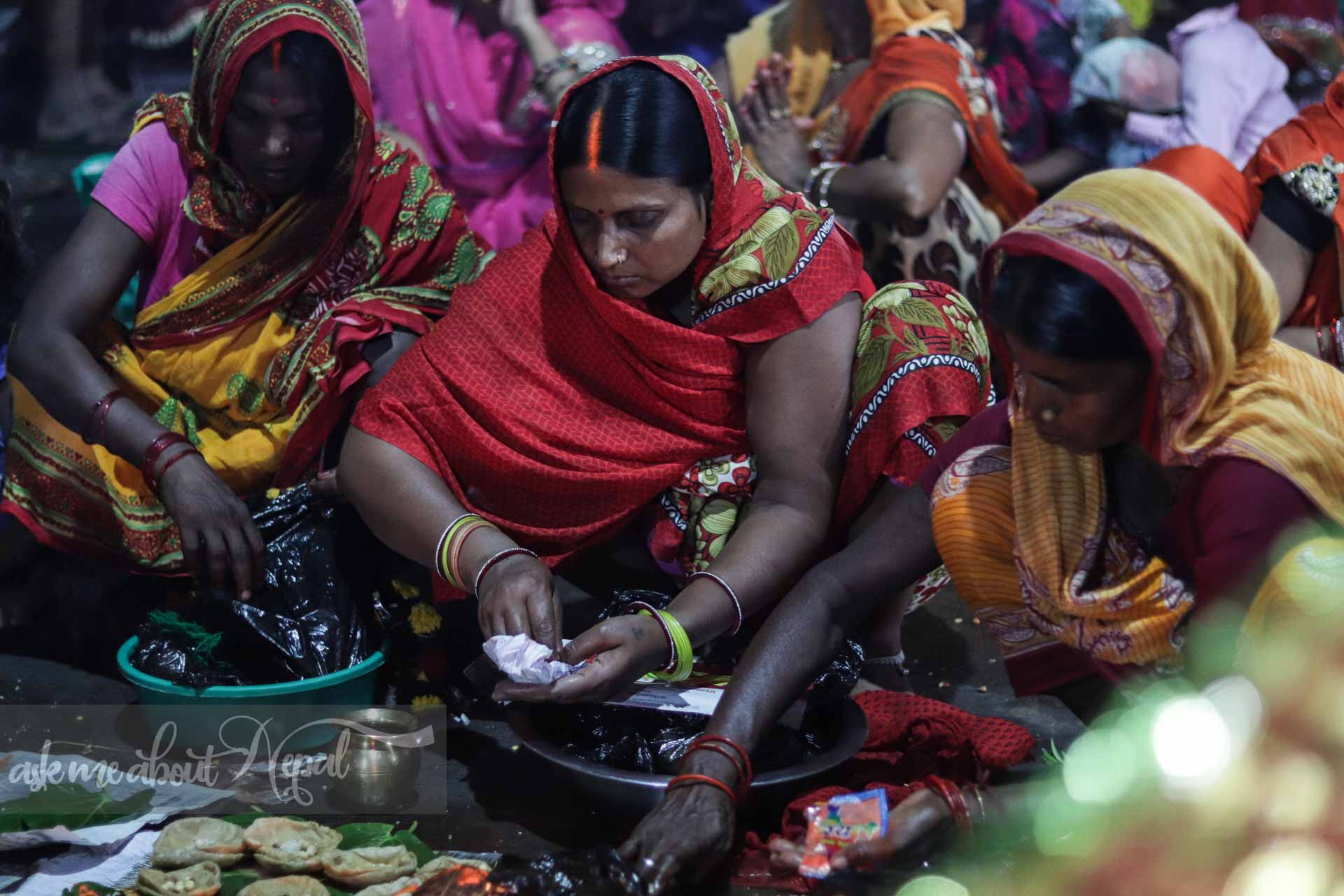
All the important rituals take place at the Ghats. The devotees must take a holy dip in the water before making Prasad, the food offerings for the ritual. A wide range of offerings is prepared during Chhat Puja, and some are made especially for this festival. One of the important Prasads of Chhata Puja is Thekuwa, the wheat flour cookie with added assortments like kismish (raisin), sukkha nariwol (desiccated coconut), gudh (jaggery) or chini (sugar), and ghee or oil. Other offerings include ‘Suthune’ (a kind of tuber fruit), ukhu ra paat (sugarcane with leaves), Sathi Dhan (black paddy), Nimbu (lemon), Gajal (a variety of big lemons), Syau (apple), Suntala (orange), Elaichi (cardamom), Hareyo aduwa (green ginger), Nariwol (coconut), Kera (banana), Gheu (ghee), and many more. All the family members are delighted while cooking and collecting prasad. One could also see Gulgule (sweet pudding) and Puri (deep-fried chapati) prepared at the eateries and street food vendors during the festival time.

The first day of Chhath Puja is called Nahay Khay, which literally means, ‘bath and eat’. On this day, the vratti (devotees) purify and cleanse their house at the crack of dawn, take a holy dip in the rivers or ponds, and eat a vegan pure meal starting their first day fast. The rest of the family members eat their meal after the vrattis’. The meal is called Kaddu Bhat (bottle gourd and rice) with dal (lentil made only from gram or mung beans). The food must be cooked either in clay or bronze utensils. The female vratti fasting eats this food in the evening time after the Sunset ritual.
The second day of Chhath has three names: Baruna, Lohanda, or Kharana. It is again only the females of the family who fast on this day. They eat nothing after the morning bath and eat their only meal of the day in the evening. The second-day fasting is a little different than the first day because women prepare Prasad called Kheer (rice pudding made with sugar and jaggery) instead of Thekuwa, the first day. The Kheer is offered to the Chhathi Maiya or Shashthi Maiya (the Mother Goddess of children and reproduction, also the sister of the Sun God) in the evening. Vrattis eat the same Kheer after offering to conclude their fast for the day, and distribute the prasad to the rest of the family members. It's a very important day for the Vrattis as they offer their fast to Chhati Maiya, the protectress. She is believed to protect one's children from any harm during the time of their nurturing. Chhati Maiya is a motherly figure usually seen carrying a child on her lap and sitting on a cat, her stride.

The third day of Chhath is called Sandhya Ghat (evening offering). This is a full, busy day preparing the delicacies and Prasad. It is the day to put on new clothes for the Vratti and family members. People donning new clothes gather either at the river banks or by the ponds, depending upon whatever water resource is available in their neighbourhood. They make a two-hour-long worship ritual to the Sun God, singing Chhath songs, and the evening arghya is offered at sunset. All the aforementioned Prasadas are also offered to Him. The Prasadas include the food items made especially at home and various fruits. These Prasadas are displayed on nanglo (bamboo trays) or mud trays, which are praised by environmentalists as eco-friendly. On this day, not only do the devotees go to the Ghats for the offering, but the whole family and relatives partake in the ritual. This evening, both the Sun and Chhati Maiya are worshipped.
The fourth and final day of Chhath is called Prana. This is the day to worship the rising Sun. On this day, Vrattis gather together at the same Ghat where they had made an offering on the third day. All the rituals (the puja processes) are repeated with lots of prasadas and fruit offerings to the rising Sun. Vrattis then return home after the full ritual and break their fast either by eating food or by drinking liquids like milk or juice.
Long ago, a king named Priyabrat, with his wife, Queen Malini, lived a content life. Later, they grew sad and miserable because Malini could not bear any offspring. They spoke about their problems and consulted great rishismunis (learned saints). Then, taking suggestions of Maharishi Kashyap (the greatest Saint), the couple organized a big Yagya (a fire offering ritual). Finally, the couple's prayers were answered and the queen got pregnant, but to their dismay, she gave birth to a dead child. The desperate king thought of committing suicide. Then Goddess Shashti/Chhathi Maiya appeared in front of him and said that she was the sixth part of the universe, and if the king worshipped her with a pure mind and soul for six days, their wish would be granted. Both the king and queen followed Goddess Shashti's advice, and they were consecrated with a baby boy after worshipping the Goddess for six days. Since then, everyone started venerating Chhathi Maiya and celebrating the Chhath Puja.
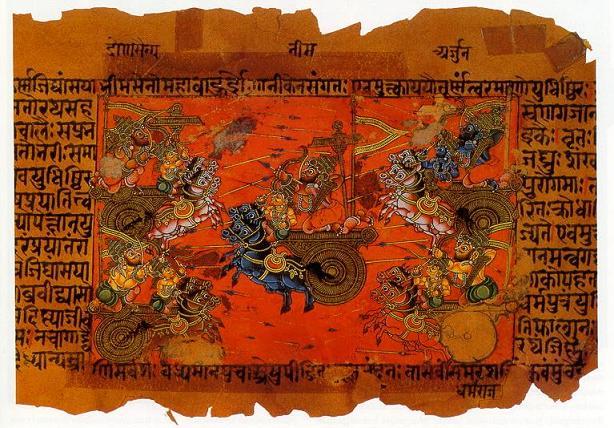
Another popular story takes us back to the time of the Mahabharata. According to the Mahabharata, one of the greatest epics of India, the five Pandava brothers were exiled from their Kingdom by their cousin brothers, the Kauravas, for fourteen long years. Draupadi, the wife of all 5 Pandava brothers, wailed in pain for her husbands' difficult circumstances. Upon seeing Draupadi's misery, Yudhishthira, the eldest Pandava brother, went to Dhoumya Muni and asked for a solution to this wretchedness. On Yudhishthira's request, Dhoumya Muni told about why people must worship Surya Deuta (the Sun God), who is the reason behind all the lives on earth. According to Dhoumya, if people worshipped Surya Deuta on the sixth and seventh day of the fortnight of Kartik Shukla Paksha with a pure heart and chant the 108 names of Surya, they get boons of a son (the carrier of the family name), trinkets, prosperity, strength, and wisdom. Yudhisthira, taking the suggestion of Dhoumya Muni worshipped the Lord Sun. The pleased god appeared before Yudhisthira and gave him a magical copper pot that cooked four types of food to feed the brothers and their common wife Draupadi. Not only did the Pandavas get rid of their hunger, but they won Indraprastha (their kingdom) in an epic battle with the Kauravas after their fourteen-year long exile. This story reassured people's faith in Chhat Puja, and the festival observant gets rid of all their sufferings.
The third story of the Chhat Festival is linked to Lord Ram, the embodiment of chivalry and virtue. He is the seventh incarnation of Lord Vishnu and also known as Ramchandra. After fourteen years of exile and victory over demon Ravana, Lord Ram and his wife Sita returned to their kingdom, Ayodhya, and fasted together in worship of Surya Deuta in Kartik Shukla Paksha during their coronation. Observing Chhath Puja then became a yearly tradition among the citizens of Ayodhya, India, and eventually Southern Nepal. Not many temples are dedicated to the Sun in Nepal, unlike India, except for the Suryabinayak Temple of Bhaktapur, which is basically a Ganesha Temple but is also believed to be, the only Sun Temple.

Only Vrattis (devotees) can confirm whether their Chhat festival wishes are fulfilled or not, but science has confirmed that there are innumerable health benefits when fasting during Chhath. Physically, Vrattis' immunity improves because they get rid of fungal and bacterial skin diseases. Their blood is purified. And mentally, they get creative, also a tranquil mind and body. Anxiety and negative thoughts are diminished. The concentration power is boosted, which helps in peace of mind. Therefore, it is advisable to celebrate Chhath as a family together. In these modern times, family structures are slowly and gradually moulding. People are extremely busy. They do not even find time to talk and share with each other in person. Children are sent to boarding schools; consequently, children are growing cold. They do not care about family happiness as they are sent to boarding schools. A new culture is emerging that is more self-centered. In such a situation, isn't it a must to celebrate the festivals together with the family? I say festivals are necessary to keep family ties fastened tight.
Gujeshwari mandir perched above the hill is hidden behind the wall or even houses. It is the most beautiful temple, one of the all-time masterpieces of Hindu Surrealism on top of that its one of 51 Shakti Pithas (holy place of cosmic power)
Sun Aug 09 2026
A polished black stone idol with 18 arms. Bedecked with silver ornaments. Drenched in vermillion. The Goddess Bhagwati holds Astra/Nastra (weaponry and symbols) Patra (vessel), Trishul (trident), Kulhadi (Axe), Damaru (two headed-drum), Chakra (disc), Gadha (mace), Khunda(scimitar), Matsya (Fish), and Ghanta (bell) on her hands.
Sun Aug 09 2026
This God of Sight took on the world's medical establishment to give the life-changing gift of sight to thousands of the world's poorest.
Sun Aug 09 2026
Shree Ngatabhulu Ajima or Naradevi or Nayatabhulu Ajima located at Naradevi is a major powerhouse that protects Kathmandu Valley
Sun Aug 09 2026
Oct 13, 2022
Jul 18, 2023
Sep 20, 2023
Jun 2, 2022


Ask Me About Nepal (AMAN) is your go-to digital platform for authentic, well-researched insights into Nepal’s people, places, culture, and hidden gems. From adventure to history, food to folklore—explore Nepal like never before!


Help us document the beauty and stories of Nepal. Your donation powers AMAN's journey.

Get captivating travel stories, hidden gems, and cultural insights from Nepal delivered to your inbox every month!
Want to Become a Contributor? Click Here
© 2025 Ask Me About Nepal. All Rights Reserved.