November 13, 2025

Sita is a paragon of womanhood—beautiful, graceful, devout, courteous, loyal, and humble. Each year, busloads of devotees from across Nepal and India converge at her birthplace in Janakpur in Southern Nepal to honor and celebrate her marriage to the God Ram of Ayodhya. This sacred occasion, known as Bibaha Panchami, is observed on the fifth day of the waxing moon in late November or early December.
In February 2024, my fellow journalist Rajeev Gurung and I embarked on a five-day pilgrimage to the newly inaugurated Ram Janmabhoomi Mandir in Ayodhya for Hinduism Today. The purpose of our journey was to commemorate Lord Ram’s return to His Janmabhoomi after 500 years. We had connected the story to Janaki Temple in Janakpur, Nepal, the sacred site where Ram wedded Sita in Treta Yug, approximately 7000 years ago; hence, Hinduism Today decided to carry a story on this sacred site where Sita was born. So here we are in the Sita Janmabhoomi, Janakpur, to witness the Ram and Sita’s Wedding Ceremony, called Bibaha Panchami.
We landed in Janakpur three days before the main event, the divine marriage of Lord Ram and Goddess Sita. The seven-day festival had already commenced, drawing pilgrims from Indian cities bordering Nepal. The influx of devotees made it challenging for us to find suitable accommodation.
The city was already brimming with fervor upon our arrival. The report estimated that around 1.5 million people arrived in Janakpur to witness the holy conjugal of Ram and Sita. The Janaki temple stood resplendent, adorned with vibrant lights, marigold flowers, and plastic accouterments, creating a mesmerizing visual spectacle. Devotees camping on the temple square were immersed in prayers, chanting, and offerings, which imbued the atmosphere with spiritual energy. Throughout the day, loudspeakers played Mithila songs praising Ram, Sita, and Mithilanchal, the kingdom of Mithila.

A busy market was held in the square opposite the Janaki Mandir. Vendors sold an array of items from colored powders, clay lamps, bangles, marigold garlands, coconuts, syrupy sweets, and posters of the Janaki Temple and its deities. Essential items for worship were in abundance. The roads and footpath leading to the temple were lined with stalls offering everything from food, fruits, clothes, bags, footwear, bangles etc, creating a vibrant and chaotic scene.

The wedding rituals span seven days, with each day dedicated to a unique cultural and religious event. The Bibaha Panchami began on November 30th with Nagar Parikrama, as the first day of the festival. “Nagar Parikrama” is a ceremonial city reenacting Ram and Laxman’s journey through Janakpur. Locals sing ancient Mithila songs to welcome Lord Ram, Lakshman, and their Guru Vishwamitra. The second day known as Fulbari Lila, commemorates the first meeting of Lord Ram and Goddess Sita. Although the actual Fulbari Lila took place in Fulhar, Bihar, India, in Janakpur, this is performed in the Puspa Vatika in a temple called Girija Mai near the Janaki Temple. The third day featured Dhanus Yagya, where Ram breaks Pinaka, the celestial bow of Shiva, winning Sita’s hand in marriage. The fourth day, Tilakautsav, performed at the open space near Ram Mandir, involving the ceremonial welcome of the “Baraati”, (groom’s party) honored by the priest of Ram Mandir. This year, 500 baraati, a special team of Vishwa Hindu Parishad, arrived in Janakpur from Ayodhya for the occasion. Similarly, numerous saints and babajis have come from India, representing several temples and math in India.
On the fifth day, Matkor saw the local women and the participating guests from Ayodhya gather mud from Gangasagar to use in the making of the bedi, the sacred altar for rituals. The main event, Bibaha Panchami, on the second last day (this year 6th December). The divine wedding was performed at the Janaki temple. The grand procession of dola, the palanquin bearing a replica of Ram and Sita from Ram mandir and Janaki mandir, exchanges garlands at Rangabhumi ground. After the exchange of garlands, the dola from the two temples reaches the wedding venue, Janaki Mandir, accompanied by music and tableaux where the local women sing and celebrate the occasion until late at night. The final day, Ramkaleva, concluded the festivities with a Mithila’s traditional 56-course feasts for the baraatis, along with gift exchanges and farewells.
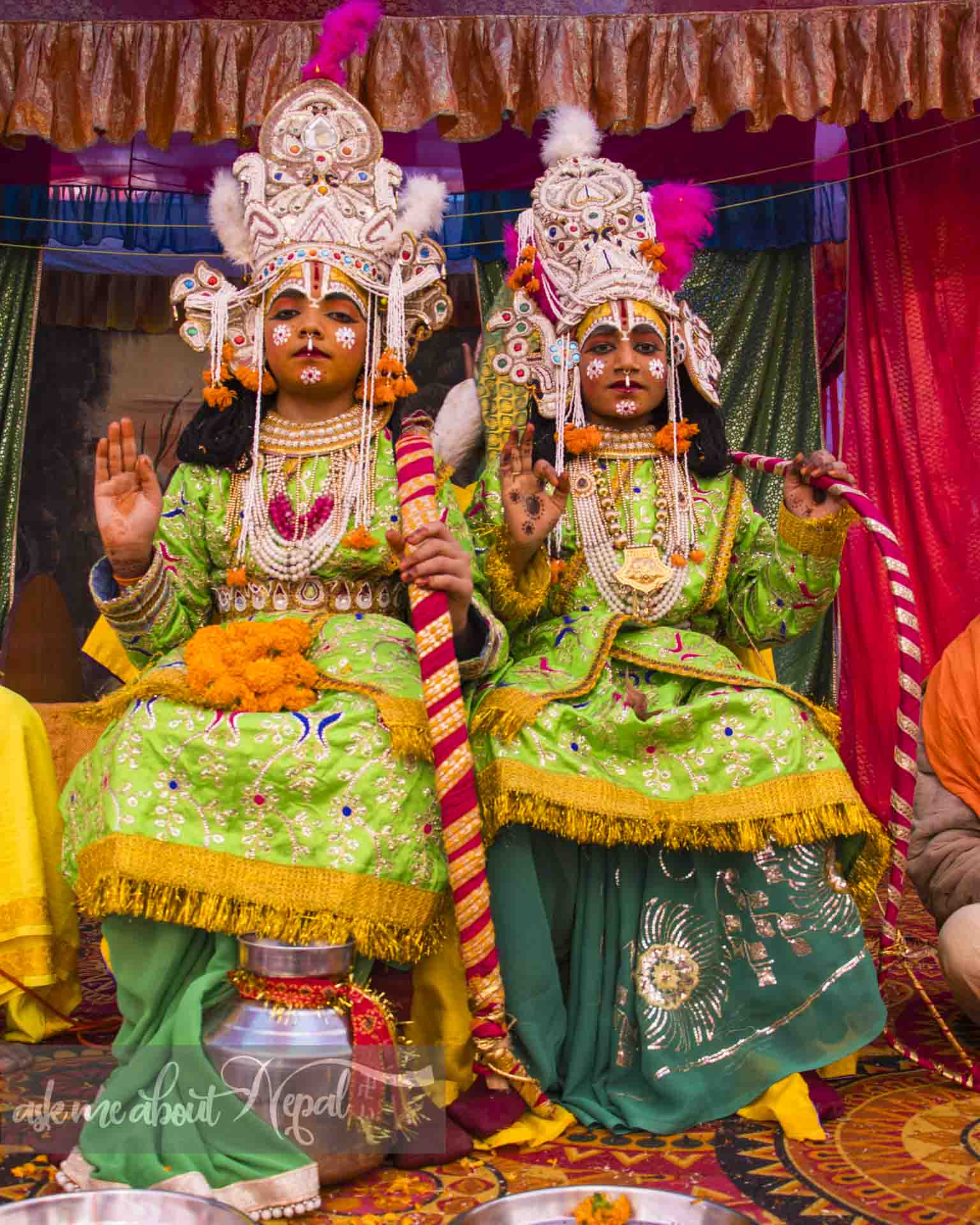
Although we arrived on the Dhanus Yagya day in Janakpur, we missed the enactment of Dhanus Yagya at Rangabhumi ground due to an overwhelming crowd. We couldn’t either attend Tilakotsav at Ram Mandir, but managed to witness the extended celebration at Janaki Mandir. Here, Mithila boys dressed as Ram and Laxman were staged. The dancers performed traditional dances to Mithila songs praising Ram, Sita, and Janakpur Dham. Later in the evening, the Sadhus from Ayodhya arrived on stage, Mahanta Ram Tapeswar Das Vaishnav, the head priest of Janaki Mandir, honored them with colorful scarves. Women of Mithila take pride in the fact that Sri Ram is their son-in-law, and they have the right to tease him. The women of Mithila playfully teased the baraatis with folk songs, a tradition that added light-hearted humor and charm to the occasion.
 |  |
Pawan Thakur, a jeweler and the Department Coordinator at Hindu Swayam Sevak Nepal, says, “Every five years, there is a tradition of sending invitations for the Bibaha Panchami festival to Ayodhya, India. This custom started around 20 years ago. On November 17, me with other delegation of 551 people led by Satish Kumar Singh, the Chief Minister of Madhesh Province, journeyed to Ayodhya in four large buses and four small four-wheelers. Following a tradition, we carried ceremonial gifts including fruits, clothing for Lord Ram and his brothers and parents, and ornaments like rings and chains to Ram. These gifts were generously donated by people of Janakpur with some donating gold ornaments, others fruits, money, or clothing. Upon our arrival, we were warmly welcomed by Champat Rai, Vice President of Vishwa Hindu Parishad, who hosted a traditional Tilakutsav, a ceremonial welcome. Our group was accommodated at Karsevakpuram and had the opportunity to of darshan at Ram Janmabhoomi Mandir.
Later, we received the baraati of 500 people from Ayodhya at Mathani and brought them to Janakpur. The Baraat, who come for the festival, retraces the Ramayan circuit, the route Lord Ram is believed to have taken when entering Janakpur, honoring the sacred journey.”
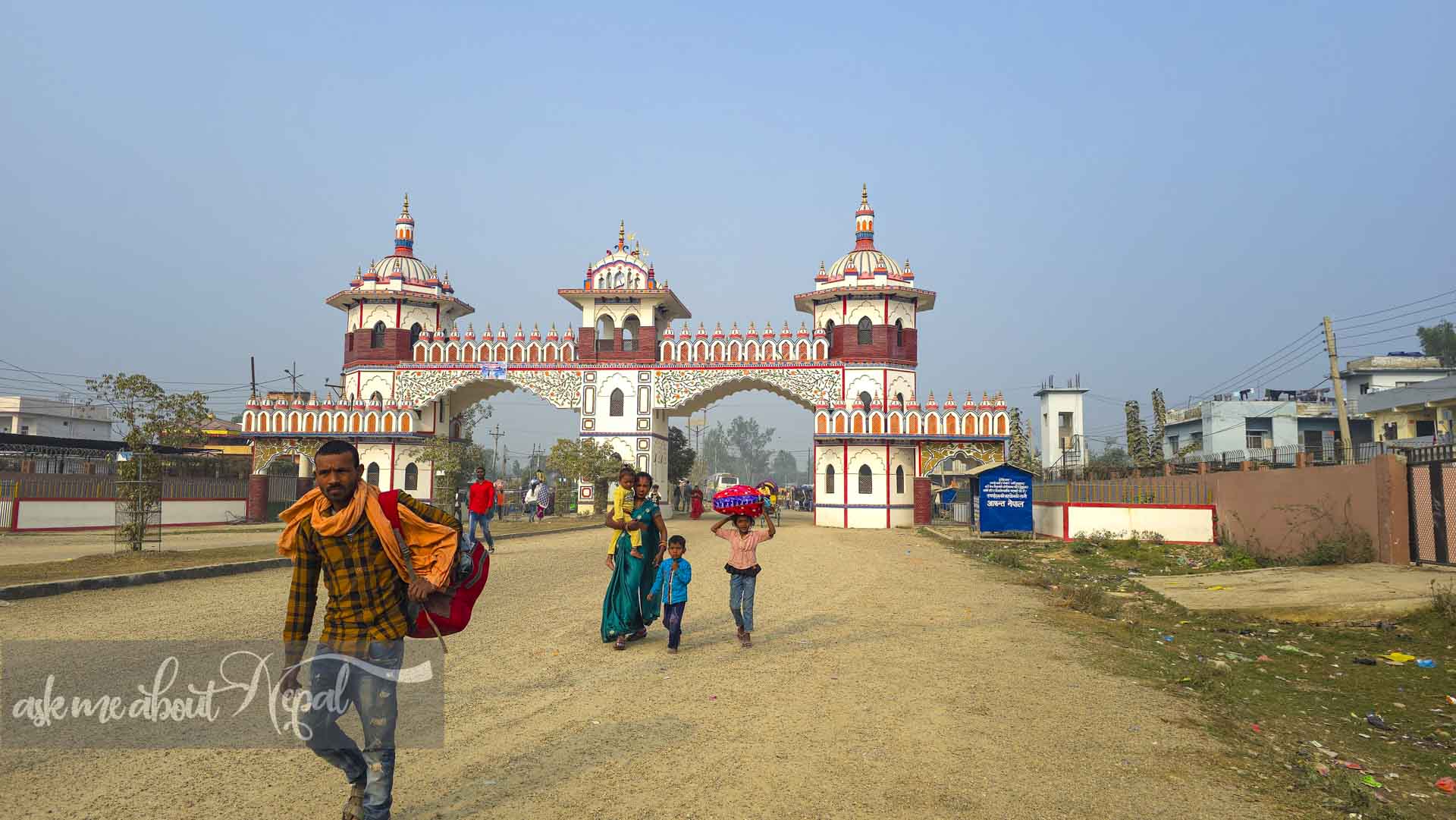
The majority of the pilgrims we met during the festival were from India, with very few from the hilly regions of Nepal. I could tell their ethnicity from their distinct facial feature and traditional attire. Many have traveled by train and bus to Janakpur and have been drawn to witness the annual celebration of the divine marriage ceremony. To accommodate these pilgrims, particularly from low-income backgrounds, several free lodging facilities were set up across. On the Bibaha Panchami day, arrangements for free meals, tea, and snacks were made to serve the visiting devotees.
We spoke to some newly arrived pilgrims at the temple with luggage on their heads. Most were traveling in a group of 35 to 50 people, often without any prior hotel reservation. Ramji Sharma, a pilgrim, from Betiya, Bihar shared his journey, “We are a family of five—my parents, my wife, and children came in a group of 35 people from Uttar Pradesh. We took a train to Sitamarhi and continued on a bus to Janakpur. We have just arrived and we don’t know yet where we will stay. Let’s see what happens”.

Another pilgrim, Pushpa, showed me her bus ticket, which detailed an itinerary starting from Darbhanga in Bihar, India, to Janakpur, then onward to the Gadhi Mai temple in Bara district, about 150 kilometers away from Janakpur, which was hosting another grand five-yearly festival, and she was equally clueless about her stay in the city like Ramji Sharma. Some pilgrims came to offer their sewa (service) at the festival. Ramji Bhai from Surat, Gujarat, explains his mission, “We are a group of 13 volunteers here to help manage the shoes of pilgrims visiting Janaki Mandir. With such a massive crowd, it is often a hassle to keep track of their footwear, while many struggle to find their shoes after darshan. This is our first visit to Janakpur, and we all feel extremely fortunate to be doing our sewa here while getting a darshan of Janaki Mata”. Similarly, Jin Mata Trust from Surat (Gujarat, India) offered a 108-meter long Chunri (shawl) to Goddess Sita at Janaki mandir on the occasion of Bibaha Panchami.
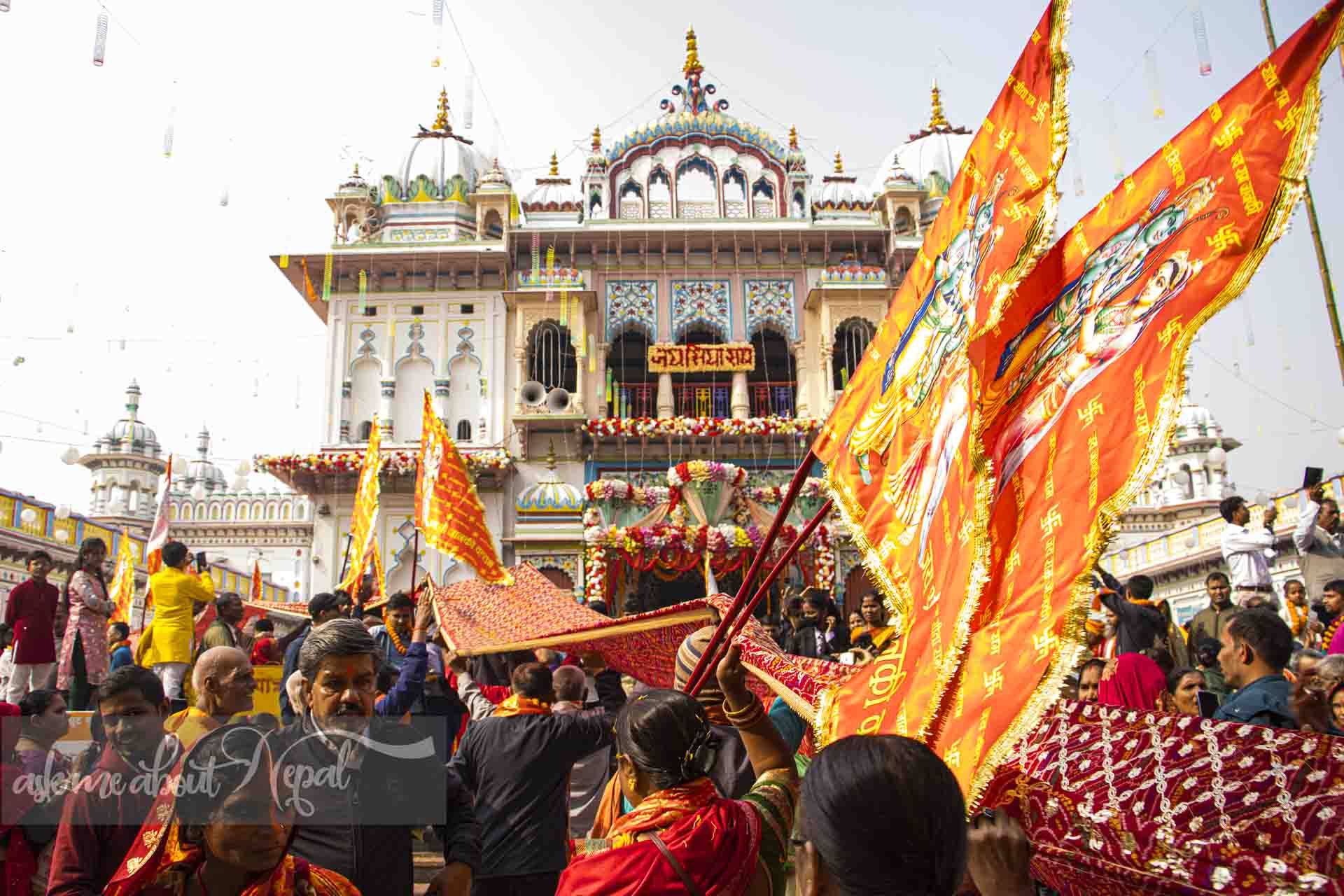
Dr. Rajendra Bimal, PhD in Linguistics, professor at Tribhuvan University, originally from Janakpur, now residing in Kathmandu, reminisced about his childhood. He shares, “If we look for the history of Bibaha Panchami, we don’t find it in great detail in older texts, which might suggest that the festival itself is only a few centuries old. We find two verses about this festival in a text called Sitopakhyan, where they mention briefly about this festival but I have witnessed the festival in its full glory when we were little kids. As a child, I felt like royalty. I could visit Janaki Mandir freely because my father was the manager of the temple for many years. It was another era, where people would come from far and wide, especially from the north of India. There were theaters, Ram Leela Nataks, circuses, markets, and dance troupes everywhere in Janakpur. The city used to be transformed from a little sleepy town into a bustling ball of light, sounds, and joy. The celebrations back then were mesmerizing, attracting people from all across Nepal. Unlike today, the festival was a vibrant gathering of the hills and plains alike”. He fondly continues, “We used to have thrilling horse races, and visiting devotees would arrive riding majestic elephants. Pilgrims from the hills of Nepal would cook sel roti, traditional sweet breads, and sing Sorathi, their traditional song and dance. People from Sindhuli, the neighboring district, would bring junar (sweet oranges) in baskets to sell at the festival. The people in those days were lucky to experience such an electrifying atmosphere, it was as if everyone came together to celebrate the holy matrimony of Sri Ram and Sita, whereas now, sadly, the music comes from loudspeakers, fading the soul of celebrations”.
 |  |
The next day, we participated in the Matkhor ritual at Gangasagar Pond, one of Janakpur’s many holy ponds. We set out with the procession of Sita from Janaki Mandir accompanied by a Nepal army band playing music and devotees singing and dancing. Followed the procession, winding my way along the crowd, and found myself a spot near where the Matkhor ritual was carried out. After an hour-long Mithila singing and dancing program for Mata Sita, and Ganga Arati, a boy dressed as Mata Sita was carried down to the Ganga Sagar shore to collect mud for the bedi. Quickly all the people with the Mata Sita hovered around her with their mobile phones making it difficult to fully experience the moment for me and a sheer number of people who were patiently waiting for the ritual at Gangasagar Pond staircase.

On December 6th, the grand day of Bibaha Panchami, we were invited by Bachan Dev Mandal, a local resident and member of the Ram Yuva Committee, to the Ram Mandir to witness the dola (palanquin) procession of Ram to Rangabhumi ground. At the Guthi office next to Ram Mandir, the preparation of the Ram dola decoration was in full swing. Ram Yuva Committee represents the baraati side in the holy marriage, and the 150 volunteers come together to make this event possible. According to Mandal, the tradition of taking lord Rama’s palanquin to Janaki temple from Ram temple (Janakpur, Nepal) is at least 100 years old and all the expenses for the Dola procession are jointly borne by Janaki Mandir and Ram Mandir of Janakpur.
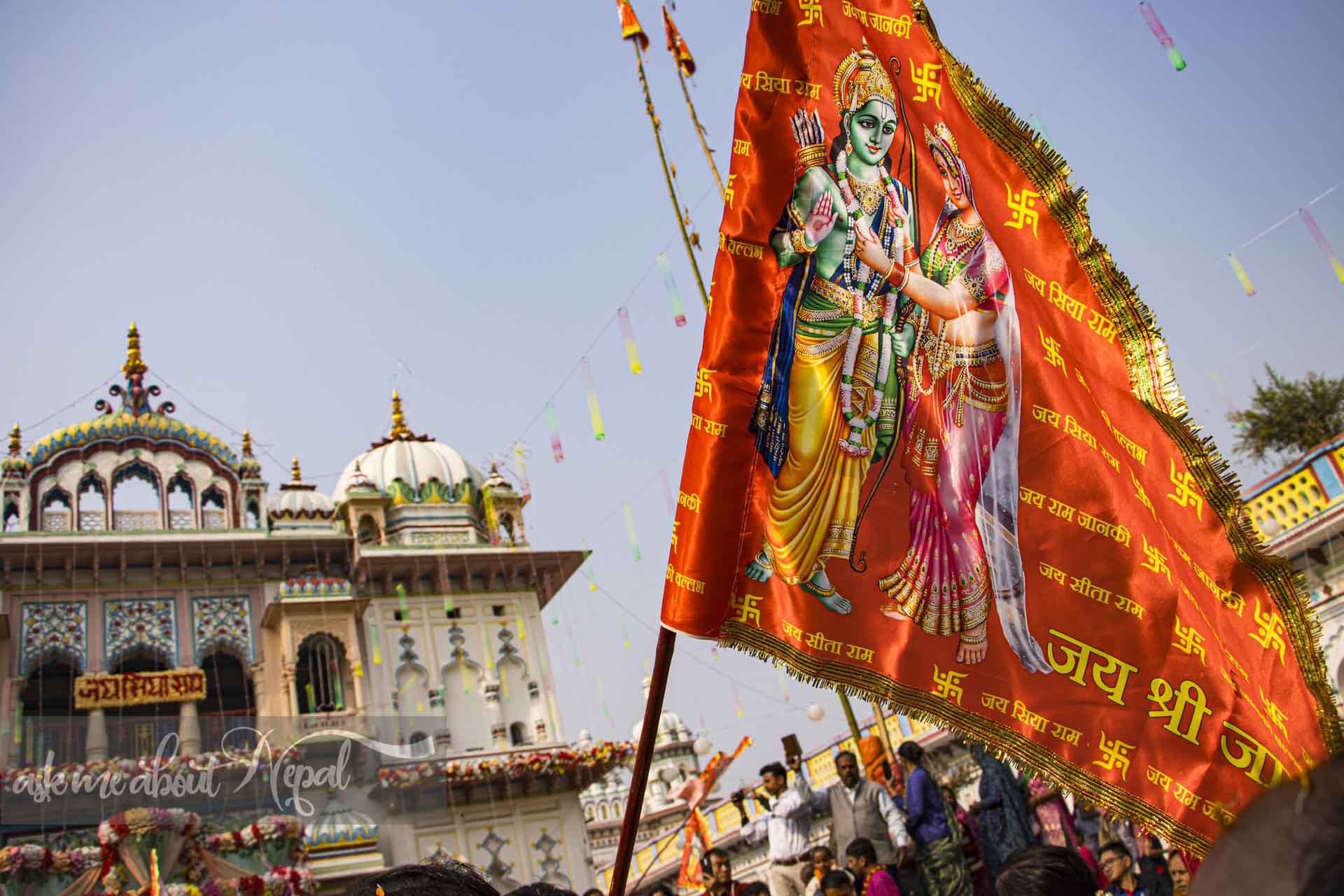
The dola carrying idols of Ram and Sita, decorated with intricate embellishments, began its journey from Ram mandir with tight security a little after one in the afternoon. Around 2000 security forces were deployed to manage the thousands of pilgrims for the festival. We stuck with the crew so that we don’t miss the event at the Rangabhumi ground. The baraati from Ayodhya joined the procession on trucks behind the dola followed by tractors carrying boys in the guise of Ram and Laxman. Hundreds of Janakpur locals lined the streets, showering the procession with flowers and sweets. We walked for almost two hours and the energy was palpable as the procession made its way to the Rangabhumi ground where Ram dola joined Janaki dola where they exchanged garlands as a prelude to their marriage ceremony in the evening. The crowd swelled, creating a vibrant yet chaotic atmosphere. I found myself squeezed between people and even a stray cow, all while Bachan Dev Mandal’s warning echoed in my mind: “Don’t trip, or you will be trampled. Being short, I struggled to find a vantage point but eventually managed to secure a few photos while holding my camera high above the sea of heads ahead of me.
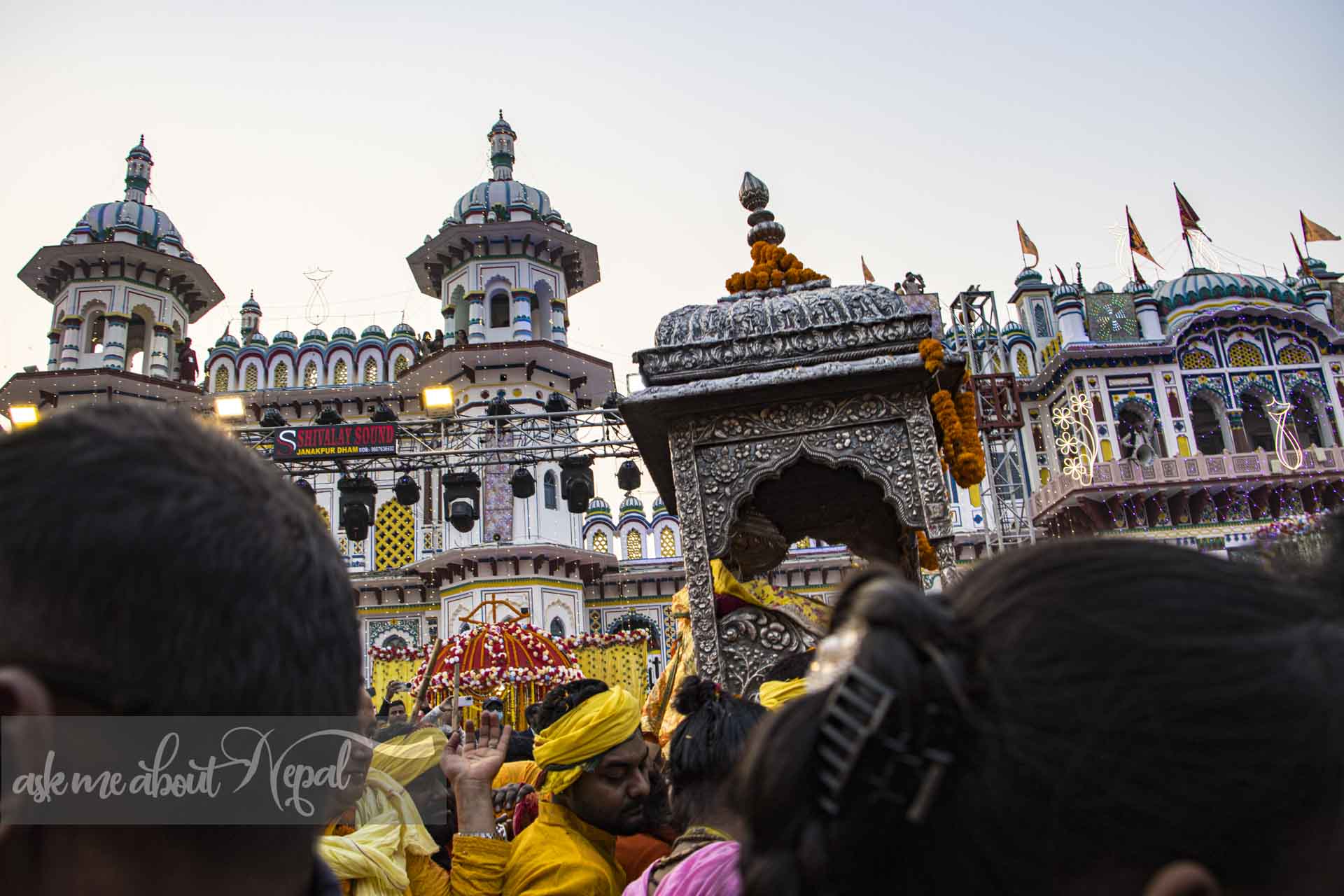
Navigating the dense crowd was challenging throughout the procession, so we took a different route/gate to exit the Rangabhumi ground and waited for the dolas at Janaki Mandir, which was already packed with thousands of devotees eager to witness the divine union. The dolls arrived at the temple amidst jubilant celebrations. However, the lack of crowd management led to moments of panic as people jostled for space. Despite the chaos, the celebrations carried on with unparalleled devotion and joy, encapsulating the essence of Bibaha Panchami.
While the celebrations continued late into the night, we had to cut short our participation due to the overwhelming crowd. Nevertheless, the experience left us in awe of the rich Mithila traditions and unshakable faith of the devotees who had converged in the city to honor Ram and Sita’s sacred union.
Apart from Bibaha Panchami, Janaki mandir comes alive with thousands of visiting pilgrims during other major festivals like Janaki Navami, all the Poornima, Vasant Panchami, Ram Navami, the Jhoola festival (in the month of Shrawan), and Ganga Dashahara.
Janakpur is recognized as a sacred pilgrimage site for Hindus due to its connection with the Hindu epic, the Ramayana. It is believed that Goddess Sita grew up here after she was found in a furrow at Sitamarhi by King Janak, and it is the place of her marriage with Lord Ram. Janakpur is 225 kilometers southeast of Kathmandu, the capital city of Nepal, and just 23 kilometers from the Nepal-India border, Bhittamore.
Janakpur, also known as Janakpurdham, was founded in the early 18th century and is the ancient capital of Mithila. The Janaki Temple in Janakpur Dham, Dhanusha district of Nepal, is a magnificent Hindu temple dedicated to Janaki (another name for Goddess Sita) and a revered center of faith of Hindus worldwide. Janaki is believed to be the incarnation of the Goddess Laxmi and the wife of Lord Ram. According to Mahant Ram Tapeswar Das Vaishnav, the head Priest of Janaki Temple, the history of Janaki Temple goes back 500 years. The sewa puja of Shree Janaki Mata has been performed continuously for the last 5 centuries, but the temple structure that we see today was built 113 years ago, where he was the 16th Mahanta of the temple.
The Janaki temple in white is renowned for its distinctive architectural style that blends the Mughal and Koiri designs, unlike any other Nepali temples which are pagoda style, the prevalent architectural styles found in Nepal. According to the legend, the temple was built by Queen Vrisha Bhanu Kumari of Tikamgarh, Madhya Pradesh, India. The construction of the temple began in 1894 and was completed in 1911. King Manik Sen of Makwanpur donated 1400 Bigha (867.76 acres)of land to manage the temple. For the people of Mithila, this temple serves as a cultural heritage site, with all its annual rituals conducted according to the traditional Mithila customs.

Queen Vrisha Bhanu Kumari vowed to construct a grand temple dedicated to Sita, valued at 900,000 gold coins, if she were blessed with a child. During her initial visit to the original, modest Janaki temple with her husband, she made this promise. After the birth of her child, Queen Vrisha Bhanu honored her vow by building an extraordinary temple and investing 900,000 gold coins. This is why the Janaki temple is also called Naulakha mandir, where Naulakha means ‘nine hundred thousand’. Although the temple is a little over a century old, experts believe that the idols of Ram and Janaki (Sita) within it date back around 500 years.
In the late 17th century, a golden statue of the Goddess Sita was discovered at this very location, where she was said to have lived. According to the legend, the temple was built on the holy site after the image of Goddess Sita was found by the Adi Mahant Surkishordas. Surkishordas is regarded as the founder of modern Janakpur who came from Lohagarh, India and was a renowned saint and poet who promoted the philosophy of the Sita Upasana, also called Sita Upanishad. Dr. Rajendra Bimal says, “Mahant Surkishordas belonged to Rasik Sampradaya, an offshoot of Ramanandi Sampradaya of Galata Muth in Rajasthan. In the Rasik tradition, there was a practice of visualizing Sita Mata as their daughter, hence Surkishor Das used to meditate upon Sita as his one child. And in the dream, Sita herself brought Mahanta to the site where he lived in a small ashram that he built where Janak’s palace was in Treta Yug”.
Tradition also holds that King Janak (Seeradhwaj), father of Goddess Sita, performed the worship of Shiva-Dhanus (bow of Shiva) on this site. The Shiva Dhanus that God Ram had to string to win Sita’s hand in marriage.
The three-storied, fifty-foot-tall temple stretching over approximately 125934.75 square feet is often compared to a palace due to its sprawling complex, colorful facades, and intricate carvings.
The main temple with an area of 4860 square feet that centers the courtyard is two stories high and surrounded by a running corridor on all sides. It is a multi-tiered structure made primarily of marble and stones. Its architectural style combines Islamic and Koiri design, an architecture that is immensely influenced by the regional affiliation of the donor. The three large domes, over 100 smaller domes and turrets, arches, intricate latticework and carvings, vibrant color glasses, and miniature towers resemble the Mughal-era architecture. The outer walls have delicate floral and geometric patterns, as well as depictions of deities and mythological scenes, painted in rich, vibrant colors.
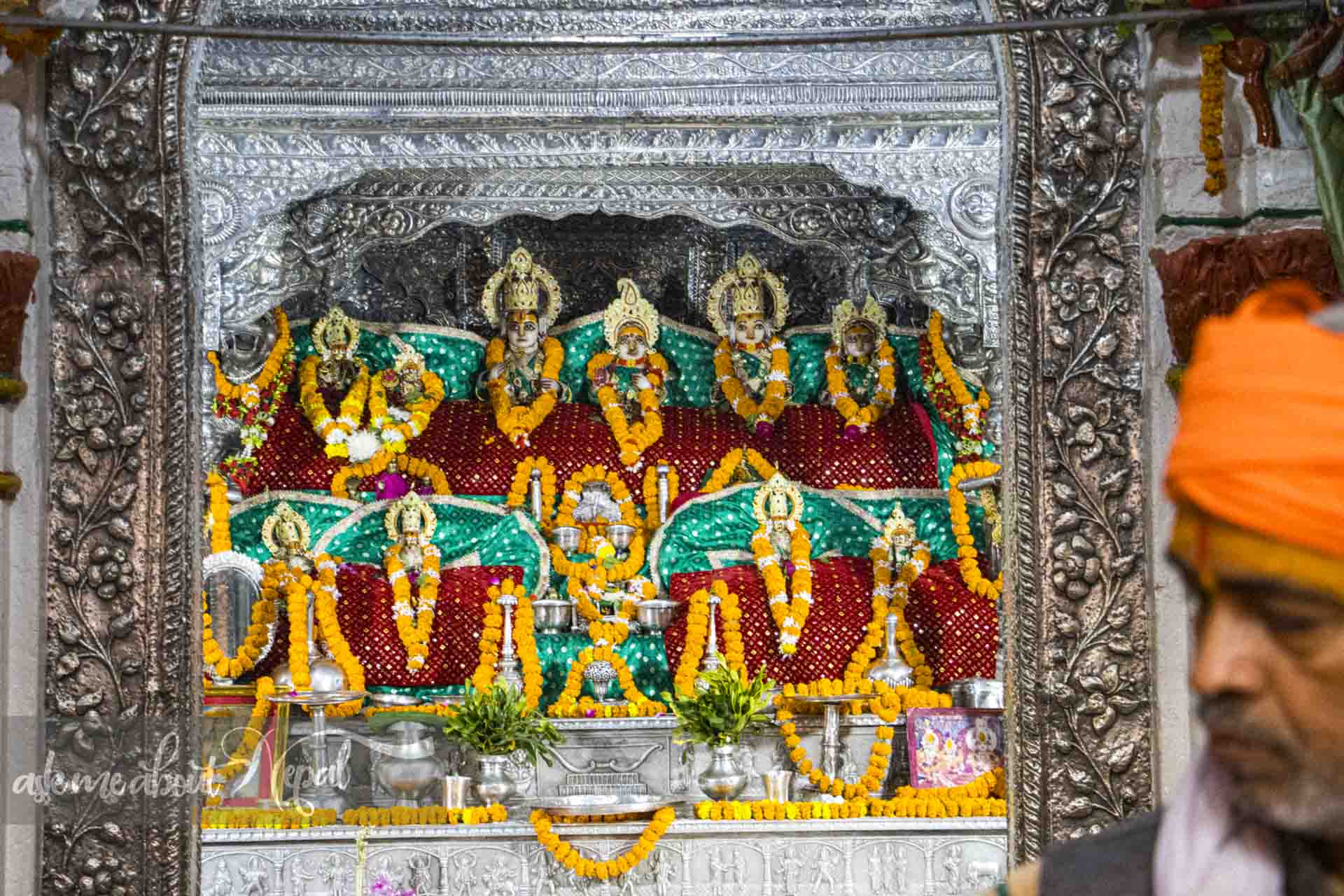
The central sanctum of the temple, made entirely of silver, houses the statues of Sita as the primary deity of the temple. Draped in ornate clothes and traditional Nepali jewelry, She is revered by devotees as the goddess of purity, strength, and devotion. Accompanying Sita to her left is Lord Ram, her husband and the seventh incarnation of God Vishnu. His statue is also equally decorated, emphasizing his royal lineage and divine nature.
Laxman, Bharat, and Shatrughna, the three brothers of Ram are also housed along with their consorts Urmila, Mandavi, and Shrutakirti, who are the sisters of Sita. All four sisters married the four brothers, strengthening the alliance between the two kingdoms, Mithila and Ayodhya.
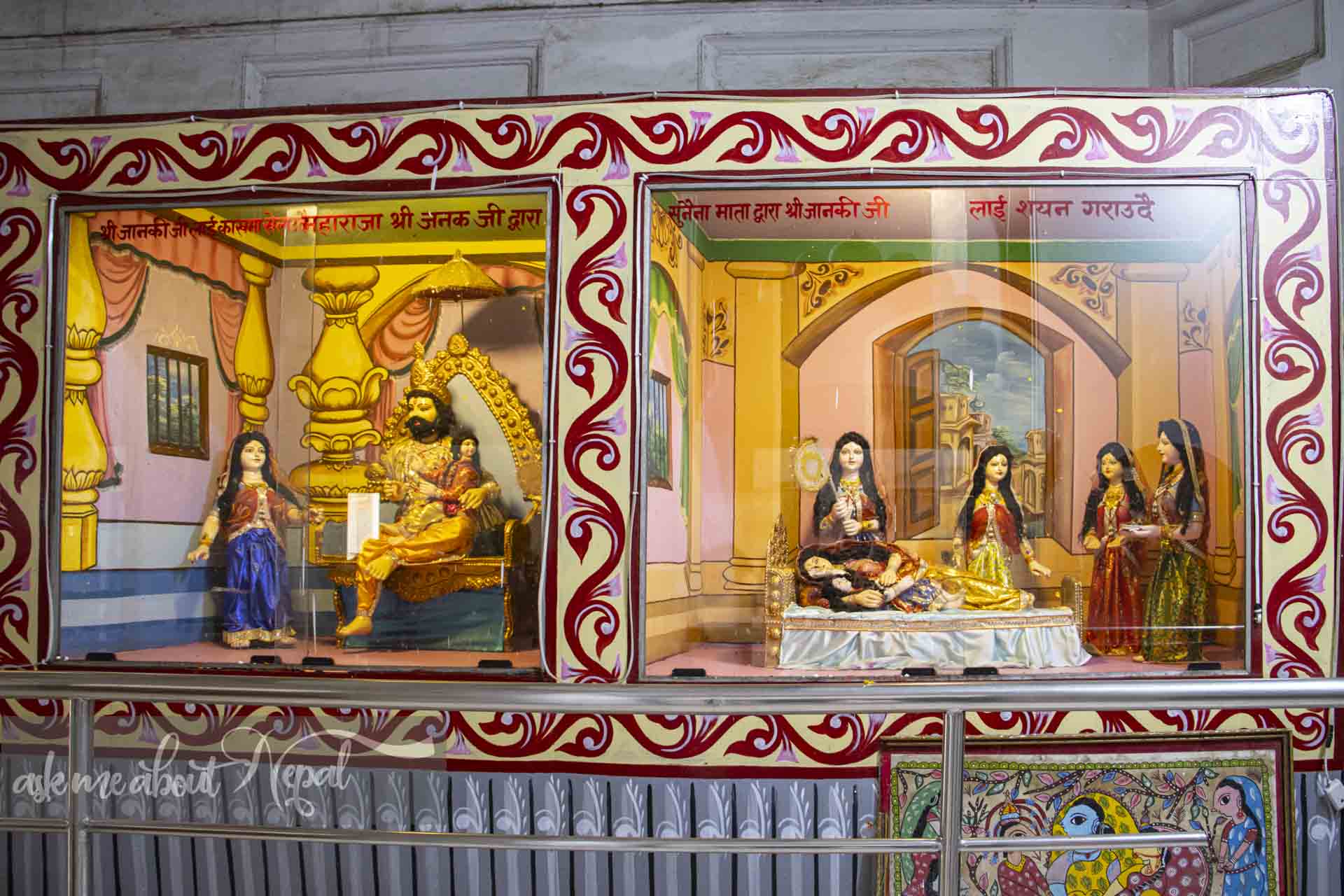
Inside the temple precinct at the back of the complex is a small museum (admission NRP 15) with some amusingly retro moving statues portraying the life of Sita and scenes from the Ramayana. Like the story of Sita found by Janak, Sita’s life in the palace, Ram breaking Shiva Dhanush, and finally the divine marriage. In the basement are a few dusty cases of Sita’s clothing and ornaments, and photos of former Mahantas of the temple. This Mithila museum, established under the leadership of Mahant Ramat Peshwar Das, houses Mithila paintings, sculptures, murals, decorative items as well as Maithili music and hymns that showcase the rich history of the art form. Hence it has played an important role in documenting and conserving Mithila art.
The temple opens every day at 04:00 hours with a bhog offering of kheer (rice pudding) to the deities. At 08:00 hours, a second bhog offering of dahi chiura (yogurt and beaten rice) accompanied by morning aarti, is made. The temple is open to pilgrims until noon, after which a full meal of rice, dal, and vegetables is served to the lords, and then they rest until 16:00 hours. The temple reopens for pilgrims, and the Sandhya aarti is performed at 19:00 hours. At 21:00 hours, another bhog is offered, followed by the shayana aarti, after which deities go to rest. All the offerings made to the gods are served to the Mahanta and distributed as prasad to pilgrims.
The chief of the temple management is Mahanta ji, there is no direct involvement of the local or national government. The temple employs around 100 people, each earning a minimum salary of NPR 15,000 (USD 100). Among them are 10 priests who take turns performing daily rituals, 5 kirtan performers for akhanda Hari Kirtan, and 5 cooks. There are 30 cows in the temple’s gausahal, with caretakers assigned to look after them. To manage all daily activities, according to Ghanshyam Jha, one of the temple administration staff, the annual expenditure amounts to NPR 1.75 Crore (USD 12600), including daily puja and food expenditures, festival expenses, maintenance of the temple, including the restoration of fallen frontal gumbaj (dome) during 2015 massive earthquake, all the expenses of the temple are covered by the donations from the devotees and income generated by temple’s property like entrance fee to Museum and Bibaha Mandap. There is no financial aid from the government. The government has taken over all the land belonging to the temple, and according to Mahant ji, they get no income from those lands either. Ananda Prasad Karmacharya, representative of Guthi Sansthan, Janakpur, echoes the same. He says, “Janaki Mandir falls under "Chhut Guthi”, a trust where the religious institutions are self-sustained and managed by their own. That’s why Janaki Mandir organizes and manages all the expenses and incomes.”
Mahant Ram Tapeswar Das says, “Becoming a Mahanta of Janaki temple, doesn’t require formal training or extensive study of scriptures. Devotion (bhakti), service (sewa), and practical management skills (vyavahara) are prioritized.” As per tradition, the current Mahant was ordained in 2054 Bikram Samvat (1997 AD) by the Mahantji of Laxmi Narayan Muth of Matihani, Mahottari district. His designated successor, Sri Roshan Das, will assume the position following the passing of Mahant Ram Tapeswar Das.
According to Ramayana by Valmiki, Janak and his queen Sunayana found Sita while clearing land as a part of a yagna. It is believed that Sita emerged from an earthen pot as King Janak, plowed the fields, praying for rain to end the devastating famine in the region. The prominent astrologers of that time predicted that rain would grace only if King Janak himself undertook the task of plowing the field. As per the Vishnu Purana, King Janak, accompanied by 88,000 sages and hermits, journeyed to Sitamarhi, 54 kilometers South of Janakpur, to perform “Haleshti Yajna” in honor of Lord Shiva. The King began plowing from the site of “Halesthi Yajna” until he reached what is now known as Sita Kund—a revered water reservoir. At this very spot, the king found Sita in an earthen pot buried in the soil. Almost miraculously, rainfall ensued, and God blessed this land with abundance and prosperity.
Overwhelmed with Joy, King Janak cradled the infant Sita in his arms and adopted her as his daughter, pledging to nurture and care for her. This is why Sita is affectionately called Janaki, signifying Janak’s daughter. Legend has it that the rain continued for six days, and on the 6th day, the baby found from earth was named as Sita, which means a line drawn with a plough, and from that moment the place is called Sitamarhi in her honor. Sitamarahi is home to a sacred pond and a temple dedicated to Sita, alongside shrines for Hanuman, Mahadevi, and Ganesha, drawing devotees from across the region.
King Janak, known for his unwavering devotion to Lord Shiva, also established several Shivalingas at the four cardinal points of his capital city, Janakpur, as part of his spiritual penance in the ancient Mithila Kingdom. The four major Shivalingas he built are: Kalyaneshwar Mahadev Mandir, Jaleshwar Mahadev Mandir, Kshireshwar Nath Mahadev Mandir, and Sapteshwar Nath Mahadev Mandir. In addition to that, the king is also credited for building the temples Haleshwar Nath Mahadev Mandir at Haleshwar Sthan in Sitamarhi and Kapileshwar Nath Mahadev Mandir at the outskirts of Janakpur Dham. These sacred sites continue to preserve the spiritual and cultural legacy of the Mithila Kingdom, embodying the devotion and piety of King Janak’s reign. For his contribution to the Mithila region, Janaka is termed a National Hero in Nepal.
The Mithila Civilization is one of the oldest and most culturally rich civilizations in South Asia and thrived under the rule of King Janak, who was not just a political leader but a wise and noble philosopher-king, scholar, and patron of learning. Mithila was the heart of ancient learning arts and governance. The Kingdom was bounded by the Koshi River in the East, the Gandaki River in the West the Ganges in the South, and the foothills of the Himalayas in the North. It now spans northern Bihar in modern-day India and southeastern Nepal, whose capital was Janakpur, located in present-day Nepal. Mithila mentioned in epics like Ramayana, Mahabharata, and various Puranas, is believed to have existed in the Vedic period and was ruled by Videha dynasty.
During King Janak’s rule, Janakpur gained prominence as a hub of knowledge, culture, and religious practices. His court attracted great sages like Yajnavalkya, Gargi, and Maitreya, whose debates and philosophical discussions are recorded in ancient Vedic texts like the Brihadaranyaka Upanishad. Under the Videha dynasty, Mithila emerged as a cradle of knowledge, dharma, and enlightenment. Many spiritual figures, philosophers, artists, scientists, gurus, and warriors originated from this land, contributing profoundly to mankind. Sadhu Yajnavalkya, the author of Yajnavalkya Smriti, which is one of the many Dharma-related texts of Hinduism composed in Sanskrit; Rishi Gautama, a pioneer of diverse philosophies and literature, and Kapil Muni, known for his advancing knowledge in counting, were among its illustrious residents.
The Mithila civilization is also renowned for its art, which is called Mithila art in Nepal and Madhubani art in India. It is a vibrant and intricate style of painting that originated in the region. Mithila Painting. The origin of Mithila art is rooted in the legend of King Janak ordering his subjects to paint the walls of homes to welcome Lord Ram when he came to ask for his daughter Sita’s hand in marriage. He had asked for paintings to capture moments of the divine marriage.

Therefore, Mithila art in earlier times was done especially at weddings and also during various festivals and feasts using flour, clay, and cow dung as a form of wall art. For thousands of years, the genre of Mithila art has remained within the bastion of its womenfolk, who bore the decorative responsibility in their homes. Women inherited their traditions, skills, and technical knowledge from their mothers and grandmothers. Mithila girls are brought up to learn from their mothers and grandmothers to paint scenes of religious lore like Ramayana and Krishna-Lila on the walls of their homes. In the days when writing for the masses was still unknown, these art forms, beyond their utilitarian purpose, also played a crucial role in educating the masses about their region’s religious literary texts. Mithila art forms vary from caste to caste, and as the art evolved, the paintings became more than a way to beautify homes; they provided Mithila women with a creative outlet to tell the stories of their lives on paper and canvas rather than just on walls. The art these days, predominantly illustrates people, their connection with nature, and scenes featuring deities from ancient epics. Sun, moon, fish, trees, sacred Tulsi plants, etc, are the common motifs. Whites, reds, and yellows are the predominant colors of Mithila art. Typically, no space on canvas is left unadorned in these artworks; gaps are intricately filled with images of flowers, animals, birds, and geometric patterns. Two years ago, I attended a Mithila Art exhibition by S.C. Suman, a renowned Mithila artist of Nepal. His canvases were filled with intricate designs and colorings, leaving no space untouched. During Q & A session, I asked him, “Where do you start painting on the canvas?” Startled by the question, he replied, “It’s different for each painting.”
Mithila art is the cultural heritage of the entire Mithila region, a single kingdom before being divided after the 1816 Sugauli Treaty. While Colonial India got a bigger chunk of the state, Nepal retained 25% of the territory, including the capital of Mithila in Janakpur, where the art form originated. Today, Mithila artists in Nepal, with their inherent skills, have uplifted their lives through the sales of beautiful artworks, exhibited their art around the world, and introduced Mithila expression globally.
Conclusion: The Bibaha Panchami festival, deeply rooted in the sacred narratives of the Valmiki Ramayana, is more than just a religious festival; it is a vibrant cultural spectacle that offers unparalleled charm for pilgrims and tourists. Janaki Mandir is not just a symbol of Nepal’s rich cultural and spiritual heritage but a place where history and mythology intertwine and past and present co-exist in harmony. Janakpur, an evolving modern city with expanding infrastructures and amenities and being the only Nepalese city that has train service since 1937, still thrives on its festivals, Mithila art, and culture, each infusing the city witha burst of color, music, and devotion.

In the southwest corner, adjacent to Janaki Mandir, is the Bibaha Mandap called Marwah in the local language, which marks the site where the marriage of Ram and Sita is said to have taken place. It’s a pagoda-style pavilion whose walls are adorned with idols of different deities in Hinduism who have descended down to this sacred place to witness the Ram-Sita wedding.
Inside the pavilion, at the center, is Ram and Sita in front of the Bedi or Yagya pit. King Janak’s family is on the left side, with his family priest Guru Sadanand ji Maharaj and King Dashrath with Sage Vishwamitra and Vashisth on the right side.
There are four other small temples around this main mandap in the four directions, and they are called Kohbar Ghar in the local language. It is believed that the four sons of King Dashrath, when married four daughters of King Janak, stayed in the Kohbar ghar, which was a part of the Bibaha Mandap.

Another well-known temple in the vicinity, built in pagoda style is dedicated to Ram. The Ram Mandir architecture is different from the other temples in Janakpur which generally bear resemblance to Mughal architecture. One of the oldest temples in Janakpur built in the late 1700s by Amar Singh Thapa, a Gorkhali General is a modestly quaint temple that is flocked by pilgrims during the occasion of Ram Navami and Dashain which are sacred and important annual festivals dedicated to Lord Ram.

Located right next to the Ram Mandir, this temple is dedicated to the Kuldevi, a clan goddess of Janaka called Raj Devi Mandir. It is located in one corner of the large courtyard that has a triangular Yagna kunda. Lions guard the walkway, indicating her to be a form of Durga.

This sacred pond, located on the east of the Ram Mandir, is a religious place of worship for Hindus where the Patala bhaana of Shiva's bow is housed. As mentioned in the Hindu epic Ramayana, Ram during the Sita swayamvara broke the bow of Shiva into three pieces. Akasha bhaana flew to Dhanushkodi in Rameshwaram, India, Bhoomi bhaana was housed at Dhanushadham and Paatala bhaana created Dhanushsagar. Locals believe that the bow was visible to devotees until the early 1980s, after which it has got submerged due to the ever-increasing pollution. Presently, the area surrounding the lake is used by roadside vendors. There are a few bathing ghats built around the lake for public use. Since the pond is directly linked to the incident of Ramayan, it has become very important for devotees who come to Janakpurdham; they essentially take a bath in this sacred pond before darshan at Ram Mandir.
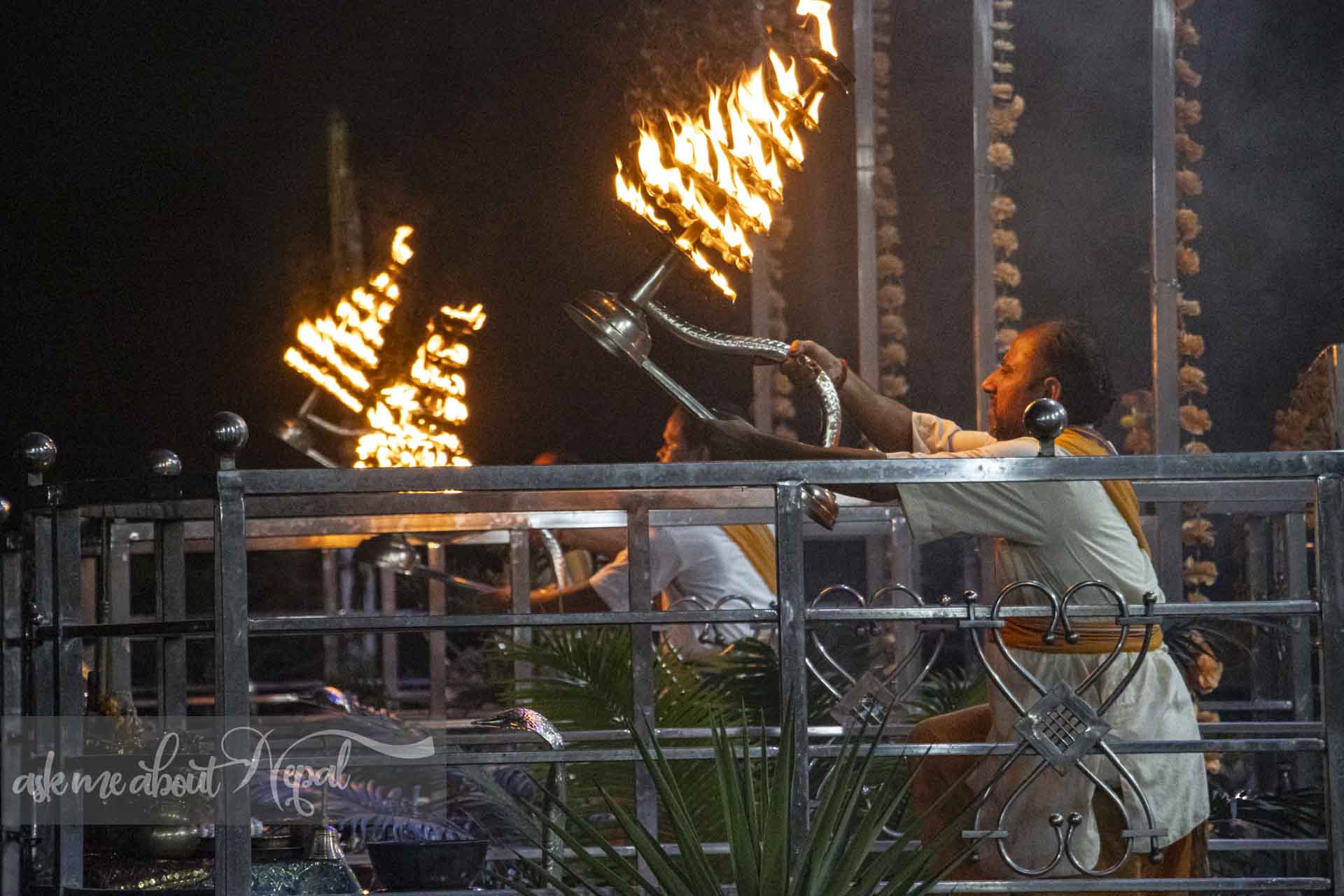
Yet another religious and historical pond in Janakpurdham is Gangasagar, situated next to Dhanush Sagar is named after the famous holy river in India – the Ganga Sagar. It is believed that the water of this pond is brought all the way from Ganga Sagar of India, thereby making it a sacred pond. At the north-west side of Ganga Sagar Pond, every evening at 7:00 PM, Ganga Aarti takes place and is one of the major attractions for locals as well as tourists. The proceedings of Aarati are similar to Aartis held in Haridwar and Varanasi in India.
 |  |
The moment of Lord Ram picking up and breaking the bow are summarised with the lines - ‘तेहि छन राम मध्य धनु तोरा। भरे भुवन धुनि घोर कठोरा॥’ (Tehi chhan Ram Madhya Dhanu toda. Bhare bhuwan dhuni ghor kathora) meaning, Lord Ram picked up the Dhanush Pinaka in no time and as he was trying to string it the Dhanush broke right from the middle. He did not aim for it to break but it did because of his sheer strength!
The mid-portion of the broken Shiva Dhanus is housed inside a cordoned-off area at Dhanusha Dham in the form of stones which is constantly growing every year and is preserved in its natural form. A historical and religious site, dating back to the time of the great epic- Ramayana is located 18 km northeast of Janakpur in the south-central region of Nepal.

King Janak, the Lord Shiva devotee, established several Shivalingas at the four cardinal points of his capital city, Janakpur, as part of his spiritual penance in the ancient Mithila Kingdom. Jaleshwar Mahadev in Mahottari is one of them. It is believed that soil was taken from this temple during the Ram Sita Marriage. According to the copper plate inscription at the temple, King Girvana Yuddha Bikram Shah provided 275 bighas (170 acres) of land for the well-being of the ancient temple in the early 1800s.
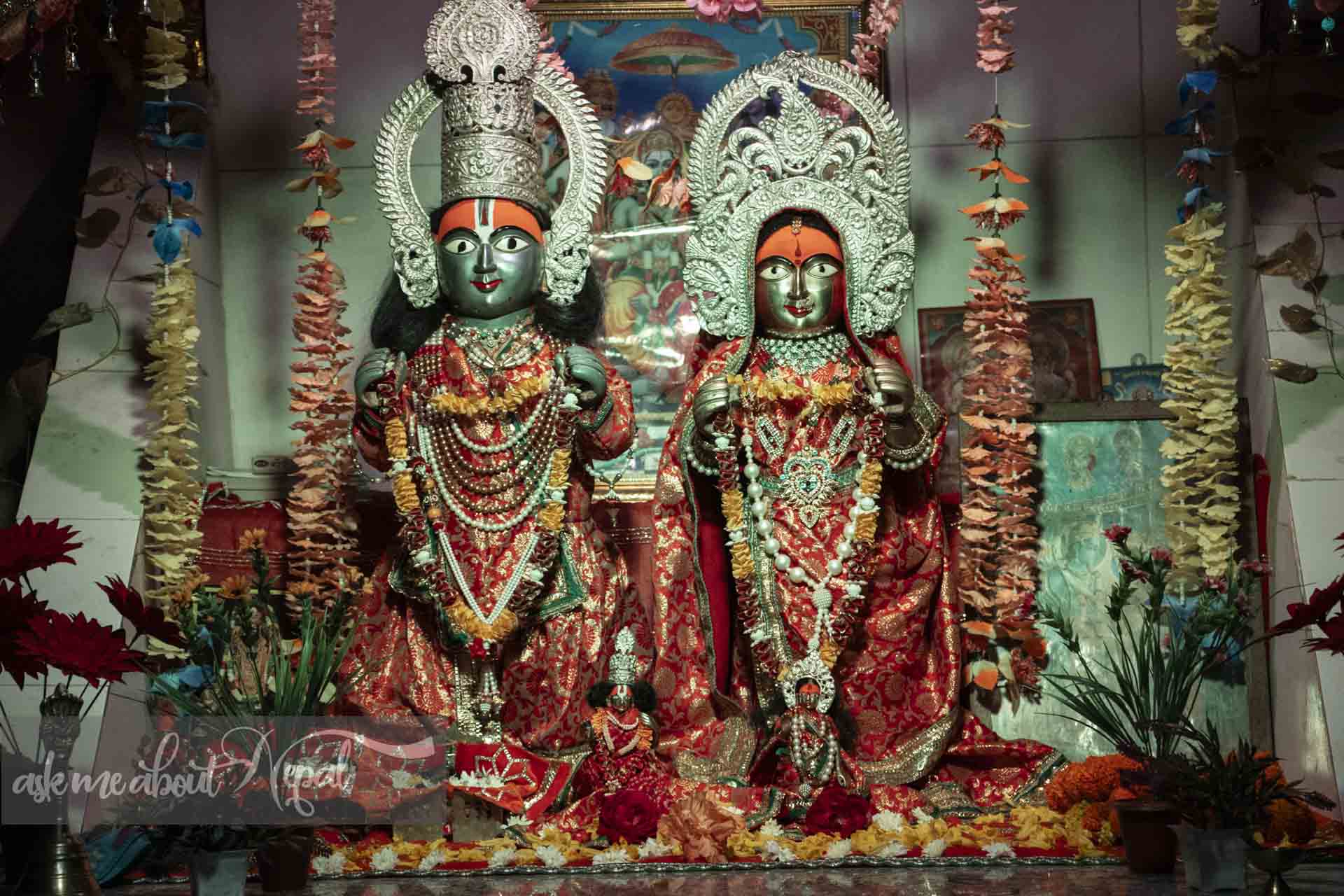
This place is called Prachin Shri Sitaram Bibaha Mani Mandap, or just Mani Mandap, as the locals call it. It is only 4.5 kilometers away from the more popular Bibaha Mandap next to the Janaki Temple. This is the actual Bibaha mandap where the holy matrimony between Shri Ram and Sita took place. It is believed that this mandap was decorated with Mani (Rubies, diamonds, etc.) by King Janak, hence the name Mani Mandap. The yajna vedi is prepared under a banyan tree near the temple, where all the rituals of the Bibaha between Ram and Sita take place during the festival. The pond in front of the temple is where Lord Ram washed his feet before sitting in the mandap, and the adjacent pond is where he washed sindoor off his hands after the wedding.
According to the Naval Das, the 3rd generation priest of the temple, the Manimandap Sewa Samiti has been formed recently for the organization of the Bibaha Panchami celebrations. The temple that we see here today was built with the financial help of a Ram devotee from Jaipur in the year 2007. Some archaeological excavations were made here on this site by the Archaeology Department of the Government of Nepal. Some ancient pots and other materials of archaeological importance were discovered at this site.
Other holy sites of interest include the Laxman Temple, Sankat Mochan Temple, Hanuman Temple, Sita Kunda, Ratna Sagar etc.
Part of the story was published in Hinduism Today on 1st July, 2025
All Photos are by Nikki Thapa
Content Creator and founder or Ask Me About Nepal
Gujeshwari mandir perched above the hill is hidden behind the wall or even houses. It is the most beautiful temple, one of the all-time masterpieces of Hindu Surrealism on top of that its one of 51 Shakti Pithas (holy place of cosmic power)
Sun Aug 09 2026
A polished black stone idol with 18 arms. Bedecked with silver ornaments. Drenched in vermillion. The Goddess Bhagwati holds Astra/Nastra (weaponry and symbols) Patra (vessel), Trishul (trident), Kulhadi (Axe), Damaru (two headed-drum), Chakra (disc), Gadha (mace), Khunda(scimitar), Matsya (Fish), and Ghanta (bell) on her hands.
Sun Aug 09 2026
Shikhali Jatra is an seven-day long festival celebrate by the Newars of Khokhana, the medieval Newar settlement in Bungamati.
Sun Aug 09 2026
In 2022, Tsherin Sherpa was the first Nepali artist ever to be represented at the prestigious Venice Biennale
Sun Aug 09 2026
Oct 13, 2022
Jul 18, 2023
Sep 20, 2023
Jun 2, 2022


Ask Me About Nepal (AMAN) is your go-to digital platform for authentic, well-researched insights into Nepal’s people, places, culture, and hidden gems. From adventure to history, food to folklore—explore Nepal like never before!


Help us document the beauty and stories of Nepal. Your donation powers AMAN's journey.

Get captivating travel stories, hidden gems, and cultural insights from Nepal delivered to your inbox every month!
Want to Become a Contributor? Click Here
© 2025 Ask Me About Nepal. All Rights Reserved.