January 11, 2026

Mountaineer Dawa Yangzum Sherpa pictured with biodegradable prayer flags in her native Rolwaling (Photo credit: Dawa Yangzum Sherpa)
Talking to Ang Dolma Sherpa, the founder of Utpala Craft, one very soon becomes aware of the three driving forces in her life: her Sherpa heritage—her parents originated in Solukhumbu; her Buddhist faith—utpala is a Sanskrit word for that quintessential Buddhist flower, the lotus; and her role as not only a producer of biodegradable prayer flags and khata (votive scarves) but also as an educator in the harsh reality of climate change and the duty of all consumers to help to alleviate it.
Ang Dolma traces her inculcation in the ethics and practices of not only making positive choices to consume products which create minimal waste but also waste management itself back to her childhood days in Asan Tole in the heart of old Kathmandu.
“My mother would only rarely use packet noodles or give us cartons of juice because of the garbage their consumption created,” Ang Sherpa recalls. “And she was particularly vocal on the issue of khata wastage. As a child, I remember spending hours each month dividing the khata we had received by colour and length. I didn’t enjoy that at all,” she adds, pulling a wry face.
It was the funeral of her father, tragically killed in a traffic accident in 2011, that unexpectedly made her focus her attention on khata.
“During my father’s cremation, I was acutely aware of a noxious smell in the air, just like the burning of plastic bags and bottles produces,” she recollects. “When I found out that the smell came from incinerating khata, which, following a funeral, cannot by reused…well…that, combined with the emotion of my father’s funeral, really had a great impact on me. I was horrified.”
As a direct consequence of this, Ang Dolma started to think seriously about how to solve the problem. Any attempt to stop using khata altogether was clearly doomed to failure: the votive scarves are embedded in Nepali/Tibetan culture and an integral part of the traditions of the Sherpa and other Mongolian ethnic groups in particular. A search for an alternative began, along with personal research into the history of khata.
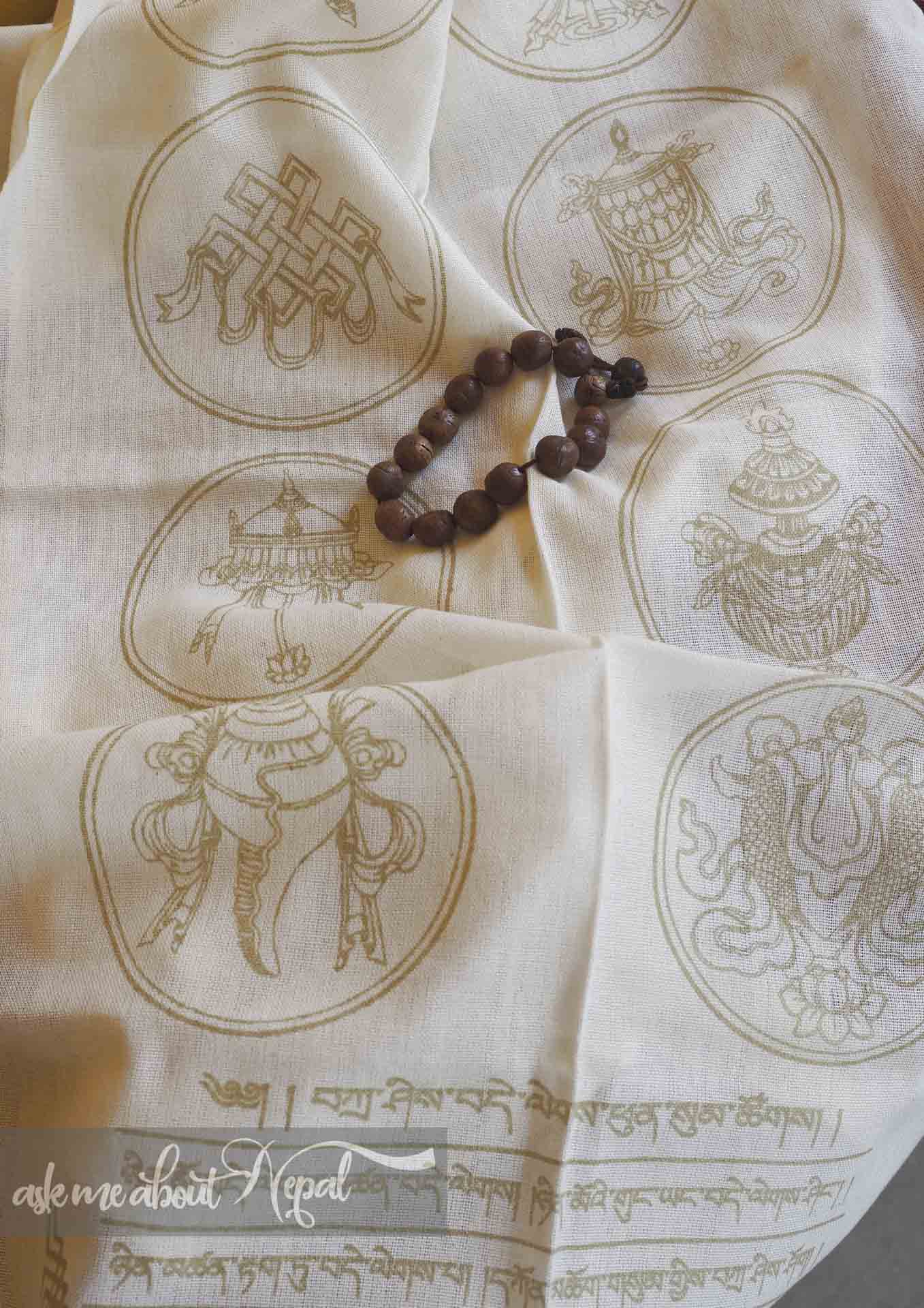
She learnt that as late as the 1970s and even into the early 1980s, white, pure cotton, khata were the norm, and that it was only over the following three decades that people became used to coloured khata in a range of synthetic fabrics, like polyester and nylon. Her research into the khata of the past turned up images of fine, cheese cloth-type khata: these were dipped in starch to give them the required degree of stiffness, with the undesirable result that the recipients’ clothes became covered in fine white powder.
And the issue of synthetic khata could not really be separated from that of prayer flags, or lung ta. Prayer flags have experienced the same fundamental shift in their concept and production as khata, from being made at home using a wooden block to print the design on white cotton—a process which in itself made merit—to being mass produced in synthetic fabric in what has become the now accepted, and indeed beloved, colour sequence of blue, white, red, green and yellow, and strung on nylon twine.

As a devout Buddhist, Ang Dolma was indirectly encouraged in the development of her plans by the commitment of her religion’s spiritual leaders to environmental issues.
H.H. the 14th Dalai Lama, who, true to his own unique style, declared that ‘Buddha would be green’ if he were to be reincarnated, became a staunch supporter of the 2015 Paris Accord, an international treaty on climate change. “What happens on this blue planet affects us all. It is not sufficient to just express views and hold conferences. We must set a timetable for change,” His Holiness has stated.[1]
In an interview given hard on the heels of the adoption of the Paris Accord, H.H. the 17th Karmapa, Ogyen Trinley Dorjee, expressed support for the promotion of sustainable lifestyles, particularly in Tibet. “The Tibetans have had a sustainable lifestyle in their region for thousands of years, but now people are turning towards a modern lifestyle and they need to think about the effect this is going to have. They need to understand what it is that makes them have a sustainable lifestyle, what choices can be made,” he stated.[2]
Ang Sherpa and her mother, having determined to commit to a pilot project and manufacture a batch of white, biodegradable khata, were initially stalled by the minimum quantities of three to four thousand demanded by most textile producers. It was only after a long search, and with a modest investment of US$100, that the first batch of one hundred white cotton khata was produced.
There have been many ups and downs along Ang Dolma Sherpa’s biodegradable khata and prayer flag journey since then, including several pivotal moments.
One was when she reached out to Dawa Yangzum Sherpa, Everest summiteer and the first Nepali woman to be awarded certification by the International Federation of Mountain Guides. Having a mountaineer of Dawa Yangzum’s standing and renown pictured stringing up white, biodegradable khata in the vicinity of Tso Rolpa, in her native Rolwaling, was a major step forward in raising awareness of the issues involved.
Another was when she got the support of a second dynamic Sherpa lady, Pasang Yangjee Sherpa, Assistant Professor of Lifeways in Indigenous Asia at the University of British Columbia, with a special interest in climate change. Author of “Sherpa Perceptions of Climate Change and Institutional Responses in Mt. Everest Region,” Pasang Yangjee has been working closely with Ang Dolma over the past several years to bring an academic researcher’s expertise and approach to the subject.
Hard on the heels of the founding of Utpala Craft in January 2020, came the spread of the COVID pandemic and the associated lockdowns and restrictions on movement. Inevitably, COVID had an impact on Ang Sherpa and her newly-established company as it did for people all over the world. However, she confesses that she recalls it as a mainly positive time.
“I like being alone anyway, so being isolated did not affect me. I was living in Patan at the time, and people were pretty much free to roam along the old alleyways. COVID actually gave me time to think in depth about so many issues,” she states.
And then there was the full moon day, 18 December 2021, when, after liaising with the Boudhanath Management Committee, and having been financially enabled to do so with donations from supporters worldwide, the great chorten of Boudhanath was divested of all its usual nylon strings of synthetic coloured prayer flags, and until late afternoon, was serenely decked out in pure white biodegradable lung ta strung on jute.
“I was scared of what I was doing,” Ang Sherpa admits. “Scared of the objections that might follow on from that.”
Ang Dolma was well aware that getting people to accept all-white prayer flags, when the five, element-related, colours have become dear to so many people, would not be easy, albeit that this was not the original concept. However, the comments made after the symbolic event at Boudhanath were primarily positive, and that gave her the courage to continue.

If she is disappointed that there has not been any shift, even partial, towards the permanent use of biodegradable prayer flags at Boudhanath since that epoch-making December day, then she is also understanding, aware that change will not happen overnight. “I believe in slow growth that will be sustainable. I don’t want to impose on people. I want to inspire, not impose,” she states categorically.
Ang Sherpa is not only a spokesperson for reduced consumerism overall, but her opinions on some issues could be regarded as outspoken. “As with all consumer products, people should not overbuy khata,” she maintains. “We need to use less, otherwise khata will become devalued in themselves. Nowadays, guests at a birthday party need to bring five to seven khata …one for the birthday boy or girl, and one each for their parents and grandparents. And for a wedding? Sixteen and upwards!” She clearly regards this as excessive and unnecessary.
Her greatest scorn is reserved for the so-called Dhaka khata, based on a traditional weave that can be traced back to Nepal’s Kirati communities. While there is a long history of this being used for Dhaka topi, the national headwear for men, she has no hesitation in condemning the Dhaka khata as an imposter, a political ploy.
“The Dhaka khata first appeared in around 2008 or 2009 as a result of a politician pontificating against the Tibetan script that appears on khata,” Ang Dolma explained. “He claimed that it stated ‘Free Tibet’ or the likes, and was hurtful to Chinese sentiments. Even worse, some people have even started to use the term ‘Tibetan Dhaka khata’….” Her indignation swelled the ensuing pregnant pause.
Utpala Craft’s production figures for 2023 are modest but impressive. A workforce of eighteen people, out of which fifteen are women—and Ang Sherpa emphasises that she will not compromise on her philosophy of only working with people who have empathy—produced 13,000 khata with a recommended retail price of 320nrp for the bamboo fibre/cotton mix, and 4000 strings of prayer flags in two sizes.
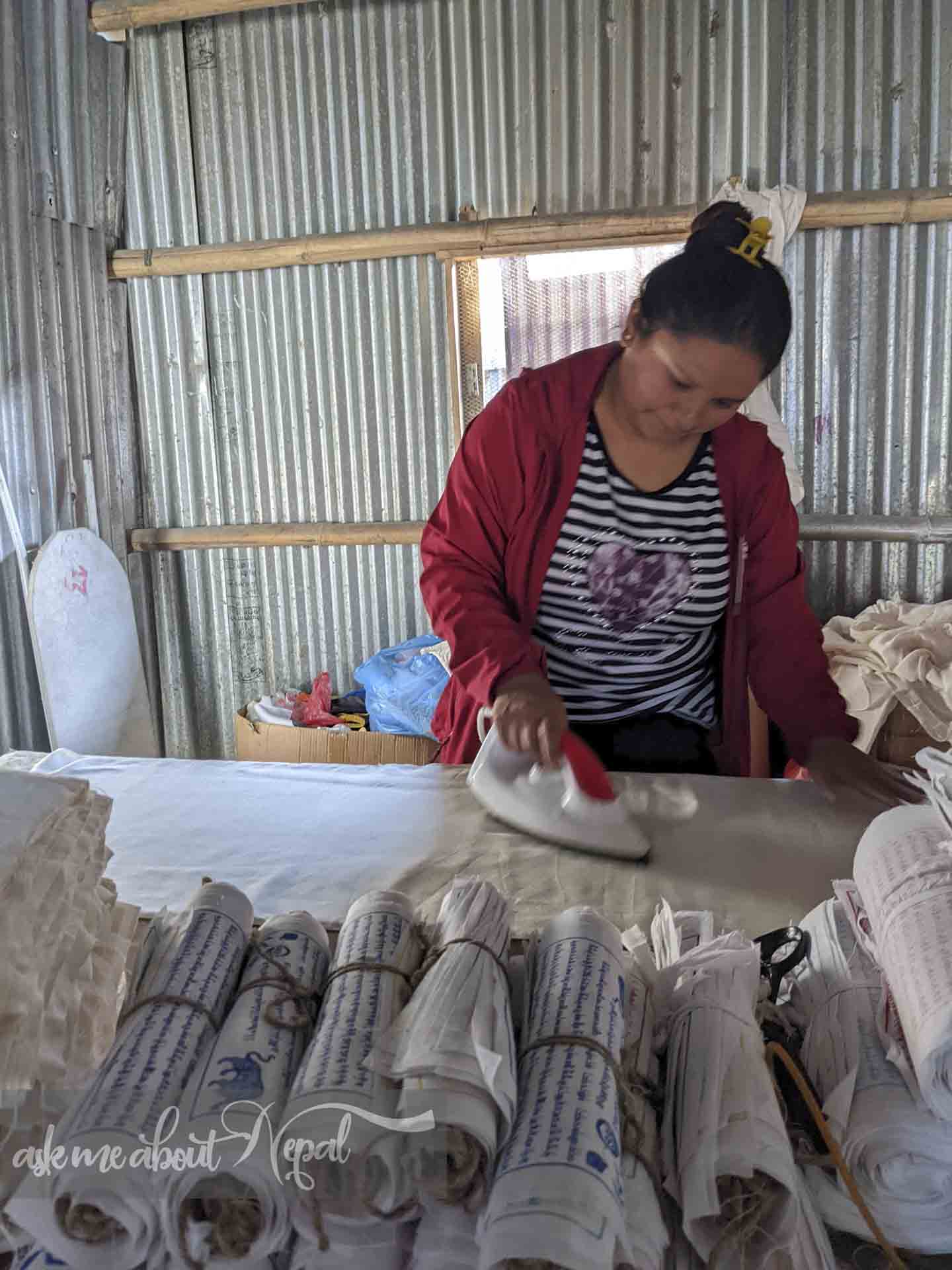 |  |
“I try to market both khata and prayer flags at prices that people can afford,” she explains. “It is really important to me that people will not hesitate too much to buy them due to the price tag.” And she makes it clear that to her ‘people’ means predominantly Nepalis: she regards her initiative as part of a growing trend to change the way that local people choose, consume and dispose of products, and that her main target market is most definitely not overseas.
“A percentage of the profit generated from our products goes towards providing subsidies for biodegradable khata in schools located in rural Himalayan villages,” Ang Dolma is keen to stress. “These communities often rely heavily on synthetic khata, contributing to a significant carbon footprint. By introducing affordable biodegradable alternatives, we aim not only to reduce the environmental impact but also to educate and raise awareness among the younger generation. The purchase of our products not only helps us to grow as a business, but also enables us to make a meaningful difference in these communities. Together, we are fostering sustainability and empowering future generations to make eco-conscious choices.”
Asked about her vision for the future, Ang Sherpa did not hold back.
“I want Nepal to stop importing synthetic khata and prayer flags from China and India. If our two neighbours want to make and export the same items to us but made from cotton, then that would be fine!” she declares. “I cannot and do not want to limit production. In fact, I want others to replicate what I am doing. Even just replacing the nylon cord with jute string would be a start. That would help to create awareness.”
But it was her closing comment that emphasised beyond a doubt to me Ang Dolma Sherpa’s sincerity and integrity. “At some point, when others are producing biodegradable khata and prayer flags, I want to leave production and move on to recycling the biodegradable khata. That is my ultimate goal,” she states, adding with a radiant smile, “Since I established Utpala Craft, the needless anxiety in my life is gone. I am happy doing the work that has chosen me!”

[1] https://www.lionsroar.com/the-dalai-lama-on-surviving-the-climate-crisis-together/
[2] https://thediplomat.com/2016/06/tibets-17th-karmapa-on-climate-change-the-dalai-lama-and-china/
A native of Manchester, UK, and a holder of a Master’s degree in English Literature from the city’s university, Louisa Kamal has spent over half of her life living and working in Asia—Thailand, Japan and now Nepal. Often referred to by friends as the builder of ‘cultural bridges’, Louisa is passionate about both preserving and promoting understanding of traditions and rituals, especially those associated with the Himalayan swathe. A winner of various awards for haiku and short stories, ‘A Rainbow of Chaos’, launched in March 2023, was her first full-length book, followed by the sequel, ‘Rainbows in the Eyes’, in April the following year. A photographer as well as a writer, she illustrates her own articles, particularly on Nepal’s festivals and rich traditions. Louisa currently lives in Budhanilkantha, Kathmandu with her partner and their dog, Maya, enjoying trekking, jatra and photography in her free time
Doko डोको is a Nepali Basket that is used to carry goods, vegetables, grains, water pots, etc since time immemorial.
Sun Aug 09 2026
Some of the famous knives of the world such as the Bowie Knife, the Stiletto, the Scimitar, the Roman Sword, and the Machete, at one time or the other, have played great historical roles as formidable weapons with raw power and courage during times of battle.
Sun Aug 09 2026
The asset details of Prime Minister Balendra Shah and his cabinet ministers were made public by the Office of the Prime Minister and Council of Ministers.
Sun Aug 09 2026
Sun Aug 09 2026
Oct 13, 2022
Jul 18, 2023
Sep 20, 2023
Jun 2, 2022


Ask Me About Nepal (AMAN) is your go-to digital platform for authentic, well-researched insights into Nepal’s people, places, culture, and hidden gems. From adventure to history, food to folklore—explore Nepal like never before!


Help us document the beauty and stories of Nepal. Your donation powers AMAN's journey.

Get captivating travel stories, hidden gems, and cultural insights from Nepal delivered to your inbox every month!
Want to Become a Contributor? Click Here
© 2025 Ask Me About Nepal. All Rights Reserved.