October 28, 2023

Nepal is a country of cultural and religious diversity. These multiplicities are recognized by the specific group of people, which means even celebrating a festival may differ from one cultural group to another. Then again, the festivals themselves are not similar to each other. We can count the number of festivals that are celebrated from a day to a full month. The cultural and religious diversities have evolved over the decades, though. Nepal is a country of festivity. It is synonymously associated with religion, tradition, and social events. Therefore, to understand the tradition, we need to observe the social measures in society, and in Nepali society, one can find plenty of festival colour canvases. When we look through the eyes of religiosity, even with a cursory glance, it may take miles to fully ascertain them. Nepalese celebrate many festivals throughout the year. Among them, the second biggest festival of Hindus is Tihar. It is also called Deepawali (festival of lights) or Yamapanchak (a five-day-long festival.) Nepali festivals always follow the lunar calendar, and the celebration of Tihar starts on the thirteenth day of Kartik Krishna Paksha, i.e., two days before the new moon in the month Kartik (Oct/Nov) and lasts until two days of the bright fortnight, i.e., Kartik Sukla Paksha.
The festival is mainly focused on the fifth day when brothers are worshipped, but the beauty of the festival lies at the core of worshipping the animals like the crow, the dog, the cow, the ox, who lived with the humans in the long run of human civilization, also goddess Laxmi, who reminds humans how important it is to collect assets in life. In addition, the special social program of Deusi Bhailo complements to the charm of the festival. Five days of Tihar feel like a tiny span.

The first day of Tihar begins with the worship of the crow. It is the day to offer food to the crow. The crows are the scavengers naturally, but religiously they are considered to be the messengers of Yama, the God of Death. The scavengers search for their food the whole year, but on this special day, they are fed well. So, they don’t have to search for food, and they get a chance to rest instead. The religious belief focuses on the fact that the crows should be served well on this special day so that they do not bring any bad news in the year ahead. So, if you are visiting Nepal at the time of Tihar and see the happy crows flying from one roof to another, you can guess that the day must be Kaag Tihar.
Another tradition for sisters on this day is to officially invite their brothers for Bhaitika Day, which occurs on the fifth/last day of Tihar. They bring in paan (areca nut chewing) and supari (bettle nut) as an invitation object, apply mustard oil on the brother's head-top three times in circular motion (clockwise) with a tiny bouquet of marigold flowers and holy dubo (bermudagrass), and tuck the same bouquet behind his right ear.
This act is called "Bhaitika ko lagi nimto diney," literally inviting brothers for the Bhaitika celebration.
Brothers following the invitation go to their sisters' on Bhaitaika day to celebrate their bonding.
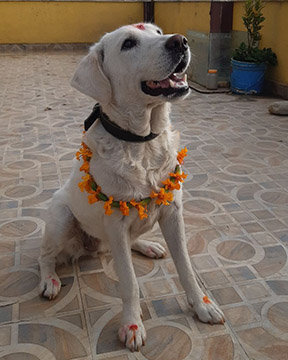
There is a saying, “every dog has its day,” and it fits perfectly with this day, Kukur Tihar (the dog’s day). On this day, dogs are worshipped and are provided with a special treat very nicely in every home. If a house doesn’t have a dog, they even find the street dogs and worship them--putting Tika, a red mark on their forehead, applying a garland around their neck, and offering delicious food. The honoring of the dogs is for the religious belief that it would guarantee the souls of the dead to enter heaven because, religiously, they are considered the guard of Yama, the Hindu god of death. Dog helps deceased souls go across the river called Baitaradi, a mythical river that every soul has to pass through in their afterlife journey of purification. When the whole country celebrates the dog veneration, the Nepal Police also worship the patrol dogs for their contribution to social security.
The national animal of Nepal is a cow. Since time immemorial, cows have been worshipped at various occasions as Laxmi, the Goddess of Prosperity, for providing the essentials of life—milk, yogurt, butter, and dung. From this particular day, the whole nation gets a three-day holiday for Tihar. Unlike the other two days, Kag Tihar and Kukur Tihar, on Gai Tihar day, people wake up early, shower, put on fresh clothes, and clean every nook and corner of the house neatly. Thanksgiving to the cow begins with the worship of cows. She is bathed, gets her forehead smeared with red vermillion powder, and is tied with a beautiful flower garland around her neck, which she ends up eating often! Special edible food items, along with her favorite greens, are fed to her. Worshippers then bow down to her feet, and humbly crawl under her stomach on hands and knees. It is on this day that the people remove the sacred yellow thread from their wrists, bestowed upon them three months before on Janai Purnima Festival, to tie on a sacred cow’s tail, praying at the same that when death comes, this sacred animal will assist their souls to heaven. Getting a large number of devotees feeding her in the early morning, sometimes makes the cow look tired and bored, probably trying to understand why there were such a large number of people around them on that day!

The evening time of this day is to worship the goddess Laxmi with much reverence. This is the day when people decorate their houses with oil lamps, candles, and bright electric lights. Most of the city houses are drenched in electric lights with attractive designs. The lightning is done to impress and invite goddess Laxmi and to pay respect for all the benefits that were and will be bestowed on the family. People also make Rangoli, a colourful floor design, following Indian tradition at the entrance to welcome the goddess Laxmi. Earlier, it was only a mandap drawing, a round patch dabbed by a mixture of red mud and cow dung. From Rangoli, a path leading towards a safe and house altar is traced with footprints of goddess Laxmi. In the evening, the lighting of the house first starts from the center of the rangoli, where a diyo, an oil lamp, is placed.
Throughout the sacred night, akhanda diyo, an eternal lamp, must be kept burning the whole night in Her honour, and lamp-black accumulated called gajal (kajal/kohl), thereby is especially efficacious in warding off disease and the dread influence of the ‘evil when painted around the eyes.
The stores and shops remain open until very late in the evening, although there is a belief that people should refrain from spending even a penny on this day to keep their wealth to themselves, which symbolizes securing goddess Laxmi at their homes. Nevertheless, the kids won’t stay at home. They would rather visit every house in the neighbourhood singing Deusi-Bhailo, traditional songs that are sung during the festival, and earn money and sell roti from happy landlords. Fireworks were heard everywhere before it was banned by the Government of Nepal. Still, you hear some big bangs now and then.
The attraction of Tihar lies in the worship of the animals to pay gratitude for their endless help to humans. Goru Puja, the day to worship the ox. Like to cow on the earlier day, people offer a fresh flower garland around the ox's neck, dab red mark on its forehead, and offer food.
Not only ox but cow dung is also worshipped on this day as a representative of the Goverdhan Hill. According to the legend, once, lord Krishna lifted Mount Govardhan on his pinky finger for the Brindaban villagers to take shelter under it to save them from the torrential rain and thunderstorm given by angry Lord Indra (the king of heaven). For these rites, a miniature Goverdhan hill of cow dung cake is formed, and pieces of sugar cane, parched rice, and lighted oil wicks are offered by women of the family. Cow dung is sacred to Nepali- an essential commodity for purifying the home and the individual, for enriching the fields, and for burning as fuel mainly in southern plains. Farmers often prostrate themselves before the dung heap, presenting offerings of flowers, lighted wicks, boiled rice, and fruits, asking that the land be well fertilized and the harvest abundant.
Mha Puja, on the fourth day of Tihar, belongs to the Newar community only and is of the greatest importance to them. It falls on the same day as Goru and Govardhan Puja. The peculiarity of the festival is that the Newars worship themselves on this day, hence the festival is called Mha Puja (worshipping oneself). Immediate family members gather in a room, each person sits cross-legged before his Mandal, sacred drawings on the floor, and a long ceremony is first performed by the father to the Mandals of Death and his cohort, then by the mother to father and sons; next by the daughter to the mother and on down to the smallest infant. They enjoy lavish food and exchange good wishes with each other on the day. It is celebrated to welcome the Nhudaya Bhintuna, the Newar New Year.

The last day of Tihar is Bhai Tika, which literally means worshipping of the brothers therefore, they gather to observe the day at their sister's place. Before beginning the ritual, siblings must purify themselves by bathing and donning fresh clothes. On a subha sait, an auspicious time allocated by the Nepali calendar, the ritual starts with sisters cracking hade okhar (walnut with a hard shell) at the main door of a house.
Some pieces of walnut are tossed into the four directions to ensure that the brothers’ troubles are thrown away and no trouble would come to the brothers from any of these directions. Firecrackers are set off to symbolically ward off any evil entering the brothers' lives. They prepare a palette of sapta rangi tika, the seven different powder colors, including one color made from dubo (cynodon dactylon). Dubo is applied first on the forehead to bless the brothers for their long life. Sisters then designate a spot and clean it with pure water, where brothers will be seated for the ritual.
The worship often takes place in an open space, which is why most people prefer it to be on a terrace. Brothers sit on a mat placed on the purified spot with crossed legs. Before them, a set of ritual items: Kalasha (holy urn), a diyo (oil lamp), and food items are laid out. Sisters circumambulate seated brothers, either three or five times, pouring oil from the pot, followed by the sacred water to create boundaries around them. Brothers henceforth are forbidden to move out of the spot before the completion of the ritual. Brothers are given spata rangi tika, garlands of makhamali (Globe Amarnath) flowers, arrays of foods that sisters have prepared all morning with the wishes, “let my brothers’ life be as colorful as tika on their forehead, and hereby I plant a thorn at Yama's door to make an entrance into death impossible.”
The brothers, in return, also worship their sisters and thank them with gifts and money. To conclude the puja, brothers are given saguna (good luck) by feeding them with curd and sweets.
According to one of the legends, Yamuna, the sister of Yama, the god of death, had wished to meet her brother for a long time. She sought help from animals like a crow, a dog, cow, but in vain because Yama didn’t reach out to her. Therefore, she visited brother Yama herself, and when she did, she wanted the meeting to be a memorable one. So, she worshipped Yama by giving him a sapta rangi tika on his forehead and a garland of Makhmali & Dubo. She circled around Yama, marking a boundary with mustard oil, and asked him not to get out of the circle until the oil around him and the garland on his neck dried. Hence, establishing a culture of sisters giving Makhamali and Dubo garland to brothers whilst seated inside the mustard oil boundary. Yamuna also prayed to Yama that no brother-sister must be separated by death on this day.
The other legend is also about a brother and a sister, but it is a little different than the first one. The legend tells that once, while a sister was worshipping her brother, Yama came to collect the soul of the brother as his days on earth were over. However, the sister asked a favor of lord Yama to wait until the ritual was completed. The sister then invited Yama for the ritual. Yama joined, observed, and enjoyed the majestic worship. Happy Yama told the sister to ask for any boon; she asked for her brother's long life, which was granted, and her brother escaped death.
In a nutshell, Tihar not only reminds us of loving nature and its fundamentals like animals, but it also reminds us of being together, loving, and caring for each other. Tihar, essentially, is the festival of unity among siblings, the social members, gratitude to God, nature, and animals. Tihar gives us a chance to rejoice in life on earth. It is a festival offered to us to bring happiness in life, understanding the importance of dependency on each other. We are all important, and we should learn to respect each other. Uniting together is the moral happiness given by the festival Tihar. Therefore, the festival mingles with happiness, love, and good wishes during the five days.
A ritual of shaving head, reciting mantras, showering flower and lava, putting tika, dhup batti. Time came for boys to get rid of their clothes and put on pitambar langots.
Sun Aug 09 2026
Mother's day or Mata Tirtha falls on the last day of the dark fortnight of April and is also the first festival of Nepali New Year.
Sun Aug 09 2026
Nepal mentioned the word “Emblem” in the 4th constitution which was called Nepal ko Sambidhan, 2019 BS (Constitution of Nepal 1962)
Sun Aug 09 2026
Yeti's Skull and hand bone remains are in display at Pangboche Monastery in Solu Khumbu District for many years.
Sun Aug 09 2026
Oct 13, 2022
Jul 18, 2023
Sep 20, 2023
Jun 2, 2022


Ask Me About Nepal (AMAN) is your go-to digital platform for authentic, well-researched insights into Nepal’s people, places, culture, and hidden gems. From adventure to history, food to folklore—explore Nepal like never before!


Help us document the beauty and stories of Nepal. Your donation powers AMAN's journey.

Get captivating travel stories, hidden gems, and cultural insights from Nepal delivered to your inbox every month!
Want to Become a Contributor? Click Here
© 2025 Ask Me About Nepal. All Rights Reserved.