December 7, 2025

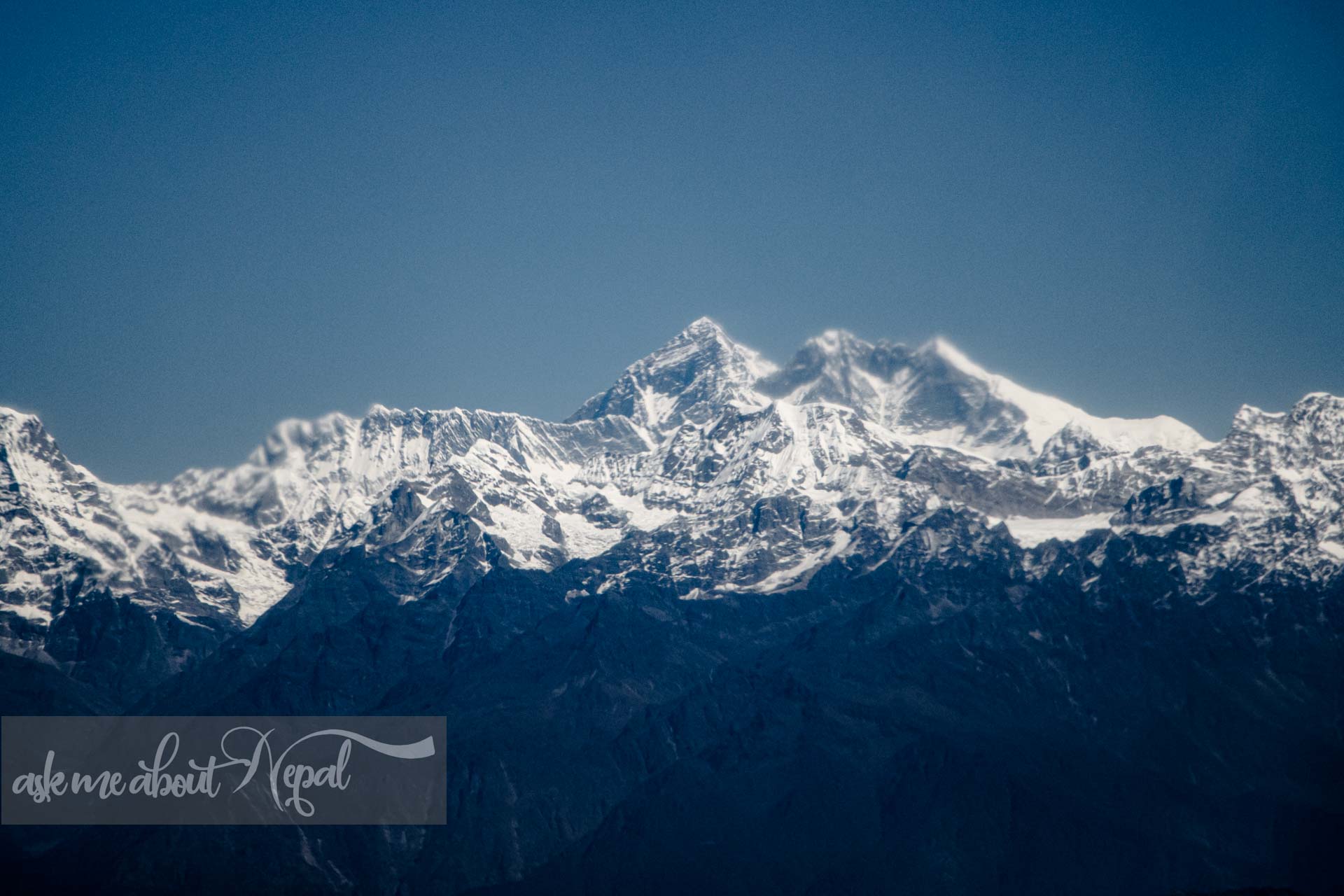
Panchakunda Lake with Annapurna I towering behind
There are treks you do for the views, and then there are treks that mean something more. This one? This one was different. I was taking my little sister into the mountains for the first time. My little sister, the one I'd grown up with, fought for, protected, and annoyed the hell out of, was finally coming with me to see what I was crazy about. And my best friend, my forever trek partner, the one who's been there through every stupid decision and every mountain high, was there too. We were heading to Annapurna First (North) base camp.
I'd be lying if I said I wasn't nervous. What if she hated it? What if it was too hard? What if I'd built this whole mountain thing up in my head and it just... wasn't her thing? But she wanted to come. She wanted to see it. So we went.
6:30 PM. Gongabu Bus Park. Kathmandu in all its chaotic glory. We loaded our bags onto a night bus headed for Tatopani, and I remember thinking, "Here we go." My sister had never done a night bus before. Neither had my best friend. I'd done a few, so I knew what was coming.
Around 3 AM, we stopped at a random highway tea stall. Everything was dark except for this one dim bulb swinging over a bench where a guy was pouring tea. We stumbled out, half-asleep, half-dead, and drank tea that tasted like it could raise the dead. My sister looked at me like, "What the hell have you gotten me into?" I just smiled. This was just the beginning.
But then it got worse. Motion sickness hit both of them like a truck. The winding roads, the constant turns, the bus driver who apparently thought he was in a Fast & Furious movie - it was a nightmare. My sister went pale. My best friend went green. I felt helpless, just holding plastic bags and hoping we'd make it through the night without anyone actually dying.
We survived. Barely.
7:30 AM, we rolled into Tatopani. Twelve hours of hell on wheels. We stumbled off that bus like escaping a war zone, our bodies stiff, our spirits tested, but somehow still intact. My sister looked at me with exhausted eyes and said, "If the trek is easier than that bus ride, we'll be fine."
I laughed. I didn't have the heart to tell her what was coming.
 |  |
We'd survived the night bus from hell, and now the real trek was supposed to begin. Except here's the thing about the Annapurna North ABC trail , it's new. Like, really new. Recently opened. Which sounds exciting until you realize what that actually means: limited facilities, no hotels, just tents, and absolutely zero network coverage. You're basically going off the grid in every sense.
I'd done my research, though. I wasn't about to drag us into the mountains unprepared. I'd found a contact in Narchyang village near Tatopani , Sabin bhai. He was our guy, the one who was going to arrange everything from Tatopani onwards. When I called him after we got off that bus, he showed up with the warmest smile you've ever seen. The kind of smile that makes you feel like everything's going to be okay, even when you're exhausted and your body hurts and you haven't slept properly in twelve hours.
We needed tea. God, we needed tea. So we sat down, let the hot tea work its magic, and that's when Sabin bhai dropped his plan on us: "Let's hike to Narchyang waterfall."
A hike? After that bus ride? We were tired as hell, but something about Sabin bhai's enthusiasm was infectious. "It's only two hours," he said.
"NARCHYANG" THE VILLAGE THAT TIME FORGOT: We started walking through the alleys of Narchyang village, and honestly? It felt like stepping into a different world. There were homestays scattered around, a small hydropower station humming quietly, and behind everything, this massive, beautiful backdrop of Nilgiri mountain just sitting there like a painting someone hung in the sky.
The villagers greeted us as we passed. Not the tourist-friendly fake greetings you get in busy areas - these were real. Genuine. Homely. Old women smiled at us from their doorways. Kids waved. This is what the mountains are really about, I thought. Not just the peaks and the photos, but these people, these villages, this life.
We climbed uphill for about an hour, and then we could see the waterfall. The Narchyang waterfall is... It's magnificent. That's the only word for it. Big, powerful, and here's the crazy part, it stays green throughout all twelve months of the year. Covered with green bushes. I'd never seen anything like it. We just stood there for a while, not saying much, just watching the water crash down, feeling the mist on our faces, letting the sound of it drown out everything else.
 |  |
The downhill back to Tatopani was easier, and we had lunch before the next adventure: the jeep ride to Humkhola.
Sabin bhai called a jeep. On reserve, it costs 8 to 10 thousand rupees, which should've been my first clue that this wasn't going to be a normal drive. The road to Humkhola? It's not a road. It's a suggestion. An off-road nightmare carved into the side of cliffs with waterfalls - uncountable waterfalls - pouring down everywhere you look.
The jeep bounced and lurched over rocks. We gripped our seats. The driver seemed completely unfazed, probably because he does this every day and has made peace with his mortality. We hadn't. Every time we got close to the edge, I could see the drop, just cliffs falling away into nothing.
Two hours of this. Two hours of wondering if we'd made it through. Yes, we made it. Somehow, we made it. Humkhola isn't much, as there's literally one hotel there. One. If you don't book it, you're screwed. Lucky for us, Sabin bhai had already arranged everything. We had a tent booked and waiting.
We ate dinner as the sun went down. Nobody talked much. We were all just... done. Exhausted. The night bus, the waterfall hike, the death-defying jeep ride - it had all caught up with us.
I lay there for a bit, listening to the river somewhere in the darkness, thinking about tomorrow. Tomorrow we'd be walking. All the way up. I fell asleep with that thought hanging over me, exciting and terrifying in equal measure.
We woke up in Humkhola with one goal: Busketmela. Just five hours of trekking, Sabin bhai said. Easy day. Which meant we could take our time, rest when we wanted, and actually enjoy nature instead of just surviving it. That was the plan, anyway.
From Humkhola, the trail went straight up. Not gradually up. Not gently up. Straight. Up. For two hours.
There was network at Guranse Danda. We knew this was it , our last chance to call home before going completely off-grid for the next two days. I called my parents. Told them we were okay, we were safe, we'd be out of reach, but not to worry. There was something heavy about hanging up that phone, knowing we were about to disappear into the mountains with no way to reach anyone. No safety net. Just us, the trail, and whatever came next. Then we moved on.
 |  |
We'd planned to stop at Phutphute waterfall for lunch. Sabin bhai had hyped it up, and honestly? He wasn't wrong. When we got there and saw that there was actually a tea house. Hot tea. Real food. A place to sit that wasn't a rock.
The waterfall was beautiful, powerful and loud, with mist rising up like smoke. Every trekker passing through was stopping to take pictures. We did too, because how could you not? But what really got me was the view. There was another waterfall directly opposite Phutphute, and the whole surrounding area was just... scenic doesn't even cover it. It was one of those places that makes you understand why people do this. Why do they put their bodies through hell to get to places like this?
We stayed for two and a half hours. Just sitting, eating, watching.
Half an hour from Phutphute, we hit Sandhikharka. We didn't stay long, just ten minutes to catch our breath, and then we were moving again. The trail led us deeper into the jungle, and an hour later, we reached Gupha Phat.
Prayer flags everywhere. Dozens of them, strung up between trees, fluttering in the wind, creating this almost sacred feeling in the middle of nowhere. We had our protein bars and tea, rested for twenty minutes, and pushed on.
That's when we started seeing the sky caves, these small cave-like structures carved into the middle of huge hills. Natural formations that looked like something out of a fantasy movie. And twenty minutes beyond that? The red waterfall.
The locals told us the story: when sunlight hits the waterfall just right, the stones glow red. Bright, burning red. That's why they call it the red waterfall. We didn't see it glowing - wrong time of day, but even without the light show, it was striking. Dark red stone, water crashing down, the whole thing just sitting there in the middle of the jungle like a secret the mountains were keeping.
Thirty minutes more. That's all that stood between Busketmela and us.
 |  |  |
We reached Busketmela exhausted but intact. Sabin bhai had already gotten there ahead of us and arranged our tent. From where we stood, we could see Tilicho Peak and the Annapurna mountains rising in the distance. Tomorrow, we'd be up there. Tomorrow.
But tonight, there was a problem.
Busketmela has a capacity for maybe 80 people. There were around 150 of us. The place was packed. Overcrowded. Chaotic. So many trekkers had shown up completely underprepared - no bookings, no arrangements, just hoping for the best. And you know what? The hotel owners fed everyone. Every single person. They let people sleep in the kitchen, in hallways, wherever there was space.
Mountain people are built differently. They could've turned people away. They could've said "not our problem." But they didn't. They made it work.
We ate dinner in shifts; the tent felt like a luxury compared to what some people were dealing with, and as I crawled into my blanket, I set my alarm for 4 AM.
4 AM. The alarm went off in the darkness, and for a moment I forgot where I was. Then I remembered: Busketmela. Base camp day. The reason we came.
We packed our bags in silence, everyone half-asleep, moving on autopilot. Outside the tent, the world was still black, but there were headlamps everywhere, dots of light moving up the trail like a procession of fireflies. Lots of trekkers were heading up. Most of them planned to go and come back the same day. Not us. We were staying. That's what we came for. We started walking in the dark.
An hour in, something changed. The vegetation just... stopped. One moment, we were walking through scrub and low bushes; the next, we were in this barren, otherworldly landscape. And that's when the sun started to rise.
Mountains. 360 degrees of mountains. Peaks catching the first light, turning pink, then gold, then blazing orange. The sky is bleeding colour across everything. It was magical.
My sister stopped walking. Just stopped. Stood there staring with her mouth half-open. This was her first trek. Her first time seeing mountains up close. And I got to watch her face as it hit her that feeling you can't describe, that moment when you understand why people chase this feeling again and again.
I didn't say anything. Sometimes you don't need to.
The trail got harder. Rocks everywhere, uneven and loose. We crossed a waterfall trail, water splashing over the path, and then followed the Sunkhola River. My sister was struggling. I could see it. She was exhausted, running on empty, hunger making everything worse. But she kept going. Step after step after step.
"I can't," she said at one point.
"You can," I said. "Look how far you've already come."
She looked back down the trail, then up at what was left. And she kept walking.
That's the thing about mountains - they show you what you're made of.
8 AM. We made it.
Panchakunda Lake spread out in front of us like something out of a dream. Blue - impossibly, perfectly blue - surrounded by mountains, sitting there like a secret the world had been keeping from us until now. Our home for the day.
We all stood there. Happy tears. Exhausted tears. Overwhelmed tears. All of it at once.
"It was worth it," she said. "Every step. It was worth it."
We dropped our bags in the tent, got tea, and just sat there watching the lake. Not talking. Not taking pictures. Just being there. Beautiful doesn't even begin to cover it.
After an hour of rest, we decided to push for base camp. We left our bags at the lake, packed tea and chocolates, and hiked the forty minutes up.
 |  |
The view from base camp was stunning. The sky so blue it looked fake. Mountains everywhere, Annapurna I right in front of us, massive and humbling. And below? Panchakunda Lake, dark blue from above, looked like a jewel someone had dropped in the mountains. Majestic. Surreal. Something out of imagination.
We had our tea and chocolates at the top, just sitting there, not wanting to leave. But we had to there was no place to stay at base camp, so we hiked back down to the lake. To our tent. To our little piece of paradise.
I'd been excited about the sunset all day, and it didn't disappoint. The light changed everything. The mountains went from gold to pink to orange, and the lake caught all of it, reflecting the sky like a mirror. Magical doesn't do it justice.
Panchakunda Lake has a temple, and we went to offer our prayers. There was something sacred about the place, something that made you want to be quiet and grateful.
We rested in the tent for a while, tired but happy. Watched the sunset paint the world. And then, when night fell, and the darkness was complete, we saw them.
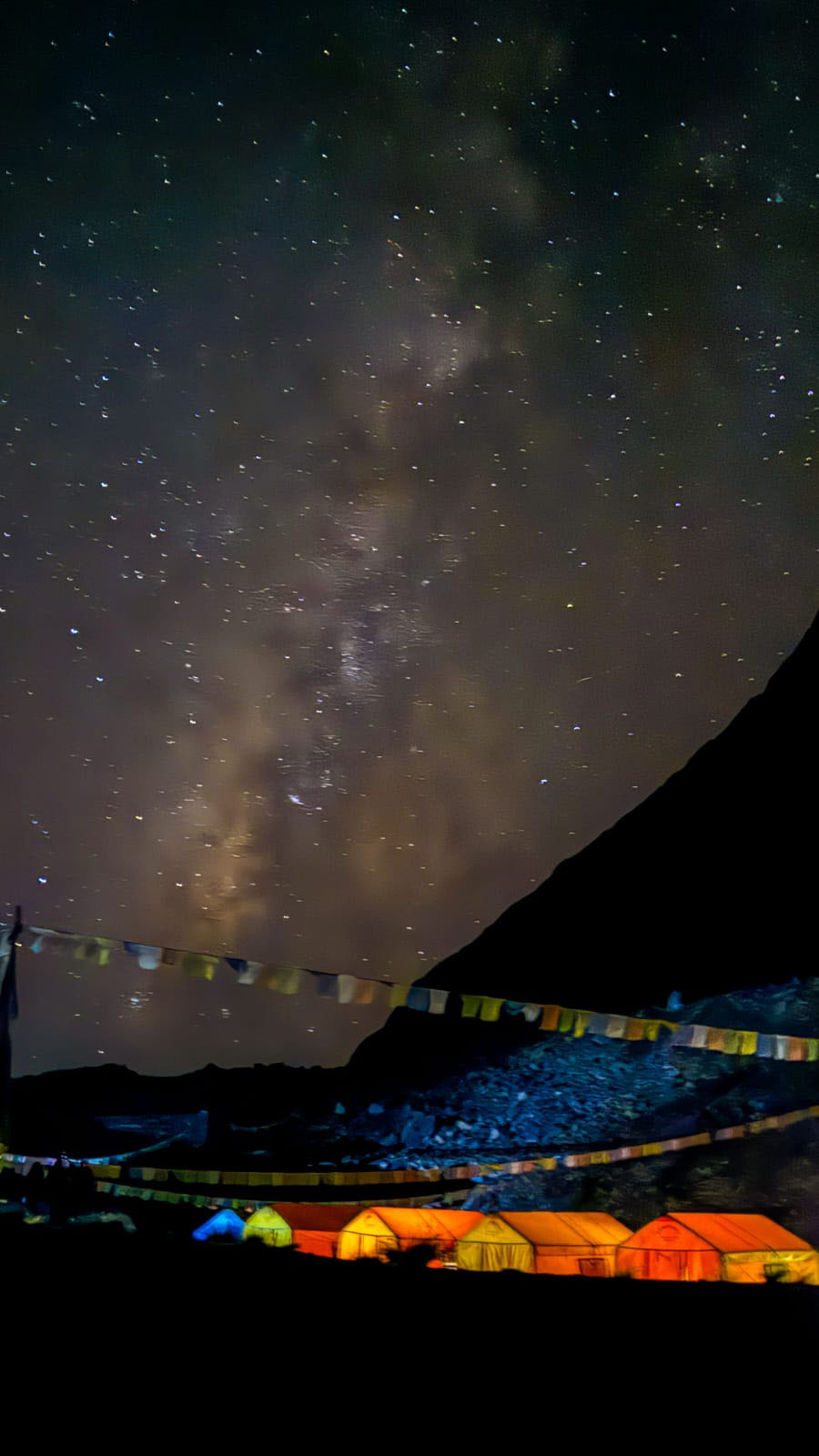
The stars came out. Not just stars - the whole universe. Star trails across the sky. The Milky Way galaxy spread out above us like someone had spilt glitter across black velvet. We were above 4000 meters, and at that altitude, with no light pollution, nothing between us and space, the sky is different. Surreal. I had my moment to capture the Milky Way Galaxy for the first time ever.
We stayed out there in the cold, necks craned up, watching the universe spin above together at 4000 meters, small and insignificant and completely, perfectly alive.
That feeling? That's what the mountains give you when you earn it.
 |  |
7 AM. Our last morning at Panchakunda Lake. The place that had broken us and rebuilt us. The place my sister would remember for the rest of her life.
Sabin bhai had tea ready for us. Hot, sweet, perfect. We clicked pictures with him, all of us smiling, and I made sure to tell him what it meant - what he'd done for us. He'd arranged everything in one of the most remote areas you can trek to. He'd fed us, guided us, taken care of us. In the mountains, people like Sabin bhai are everything. They're the reason you make it. The reason you come home safe.
We wanted him to know he was special. That his efforts mattered. Because they did.
Downhill is supposed to be easier. That's what people say. Those people are liars.
Two hours down, we reached Busketmela. Had breakfast. Said goodbye to the place that had somehow fit 150 people when it should've only held 80. Then we kept walking.
The whole journey down was humbling. The people we passed - locals carrying impossible loads, other trekkers pushing through their own struggles. The nature: still beautiful, still overwhelming, even on the way down. Mountains don't care which direction you're going. They're magnificent either way.
We stopped at Phutphute waterfall for lunch. Same place we'd stopped on the way up, but it felt different now. We were different now. We'd done it. We'd made it to the top and back.
 |  |  |
4 PM. Humkhola. We'd walked all the way down, and now it was time for the jeep ride back to Tatopani. Sabin bhai had arranged everything. Of course, he had.
Here's the thing: it was Tihar. Laxmi Puja day, specifically. Which meant there were only two jeeps available, ours and one for another group. Two jeeps. And about forty people desperate to get down.
It got ugly.
People who'd come completely unplanned, who hadn't arranged anything, who'd just shown up hoping it would all work out, they were angry. Yelling at the locals. Demanding rides. Throwing tantrums as if the mountain people owed them something. It made me sick. You don't come to remote areas unprepared and then blame the locals when reality doesn't bend to your expectations. That's not how this works.
We waited. And waited. People were blocking our jeep, arguing, refusing to let us leave even though we'd actually made arrangements. Finally, at 7 PM, our jeep started moving.
Off-road. In the dark. With a few locals we'd helped squeeze onto our jeep because that's what you do, you help each other in the mountains.
Halfway down, we found another jeep stuck on the trail. Completely blocking the way. Our driver got out, walked over to me, and said, "Hold the brake."
Hold the brake? What?
He wanted me to hold the brake pedal while he got out and helped the other driver. In the dark. On an off-road mountain trail. With cliffs dropping away into nothing on one side.
It was crazy as hell.
But that's Nepal. That's mountain driving. These drivers can do things that seem physically impossible. Our guy helped clear the stuck jeep, got back in, took the wheel, and navigated us down like it was nothing. Like he hadn't just trusted some random trekker to hold the brake on a death trap of a road.
Unreal.
9:30 PM. We rolled into Tatopani. Tired. Happy. The trek was over.
I need to say this clearly: Sabin bhai made this trek possible. In one of the most remote areas you can go, with limited facilities, no network, and barely any infrastructure, he arranged everything. Food, tents, guidance, and tea at 4 AM in the morning. He was the best kind of person, the kind who takes care of people, who makes the impossible happen.
If you're going to North ABC, find someone like Sabin bhai. Better yet, find Sabin bhai himself. You'll need him.
This trek was surprisingly beautiful. One of the most scenic I've ever done. Raw. Remote. Real. The kind of place that reminds you what mountains are supposed to feel like: not commercialised, not overcrowded, just you and the trail and the people who live there.
It was humbling. Watching my sister see mountains for the first time. Watching her struggle and push through and make it to the top. Sharing it with my best friend, my forever trek partner. Being taken care of by mountain people who gave more than they had to give.
I came back different. We all did.
That's what the mountains do. They break you down and build you back up. They show you what matters. They remind you that you're small, but you're strong enough.
My sister is a trekker now. She's been to the mountains. She's earned it. And I got to be there when it happened.
 |  |
Pratigya Sedhai is a dedicated QA Engineer with a keen eye for detail and a commitment to ensuring flawless digital experiences. Beyond her expertise in software testing, she is a passionate writer, traveler, and explorer who finds joy in storytelling and discovering new perspectives. Whether she's crafting insightful articles, embarking on new adventures, or diving into the intricacies of quality assurance, Pratigya thrives on curiosity and continuous learning. Her ability to blend analytical thinking with creativity makes her a dynamic professional and an enthusiastic seeker of knowledge and experiences.
Walk with me to the Annapurna Base Camp Trek is the most famous trekking routes for national and international visitors.
Sun Aug 09 2026
This 10-day long trek was a genuinely laborious spiritual experience. It pushed me out of my comfort zone, broke all my limitations and its made a special home in my heart forever.
Sun Aug 09 2026
Taal Barahi Temple that centerst Fewa Lake is a famous religious & touriste site in Pokhara. It is also called Lake Temple or Barahi temple.
Sun Aug 09 2026
Sorah Hattey Ganesh, Lord Ganesh with sixteen hands is housed in a one-storey Gambuj (dome-style) temple at Bhotahity, central Kathmandu.
Sun Aug 09 2026
Oct 13, 2022
Jul 18, 2023
Sep 20, 2023
Jun 2, 2022


Ask Me About Nepal (AMAN) is your go-to digital platform for authentic, well-researched insights into Nepal’s people, places, culture, and hidden gems. From adventure to history, food to folklore—explore Nepal like never before!


Help us document the beauty and stories of Nepal. Your donation powers AMAN's journey.

Get captivating travel stories, hidden gems, and cultural insights from Nepal delivered to your inbox every month!
Want to Become a Contributor? Click Here
© 2025 Ask Me About Nepal. All Rights Reserved.