February 17, 2019

Travelling to Lamjung was a good start. I have been planning this trip for a month now. Moving dates ahead and back. One day, my assistant announced he had needed a week off for his sister’s marriage, and I took this opportunity to make my travel plan. My brother had just returned from his Mardi trek, boss and assistant both going away for a week. It was a perfect getaway time. My brother was happy I cherry-picked him instead of mom, who was supposedly my travel partner from the start to Lamjung along with my two other cousins, who cancelled due to an unsuitable situation at their home. So mom was dropped out, and he got on the board.
This was my first-time travelling to the city. It is my sir’s gau (village/town), well, technically he is not my teacher, but he used to be one of the Nepali teachers at my relative’s boarding school for a very long time, hence the term “Sir”, and he is well acquainted with all the family members.
Anyway, we took a microvan from Gongabu, nice and comfortable. Scenic, not so unique halfway, it was the same hills and jungles and making several unlikely mini-stops until Dumre.
The weather was perfect, bright and sunny up until the diversion from Dumre. As we approached Marshyangdi Hydro Reservoir, there was a one-eighty-degree turn on the day, as if storm, rain, hailstone, and micro-van were racing against one another to reach Besi Sahar first. Neither of the four wanted to lag behind.
I was busy GoPro-ing every event on a commute that I completely forgot to call Sir to announce our arrival, consequently passing our get-off stop called Sera and reaching the Manang Highway. Thankfully, the driver and his friend were friendly, so to speak. They spoke to Sir over the phone and guided us to a nearby hotel at Manange Chautara at the end of the Besi Sahar lane.
Did you know Besi Sahar was not how the place was originally called? There is an interesting story on how this place got its name. The Shah Royals then, Drabya Shah and his successor had two Palaces, Summer & Winter. Summer one was up on the hills called Gau, and Winter one was in Besi, the foothills. So, when the Royals moved to the Summer Palace, her fellowmen announced “Raja Gau Sare” (King moved to Gau), and similarly, when the Royals moved back to his Winter Palace, the announcement would be “Raja Besi Sare” (King moved to Besi). Just like the Chinese Whisper game and passing down of words to generations, Gau-Sare & Besi-Sare eventually became Gau Sahar & Besi Sahar.
Back to our journey story of that day ending at Manange Chautari amidst downpour, storm & hailstone, we found one room with twin beds and no attached bathroom. Further to our dismay no electricity and no Internet.
We spent the whole evening chatting with owners with hopes of getting out if the rain stopped. But no luck! We were there sitting, drinking coffee, eating a meal, and counting stores closing down one by one beyond the glass window and incessant rain.
I remember we avoided drinking water to duck running to take a piss at a cave-like toilet right down the end of the hallway, and also praying that the night would somehow quickly pass and we get out of the Sahar ASAP.
The next morning was rather calm, the sky opened up, and my eyes too at 05:00 hrs. First thing I noticed was the candle from last time has melted to levels, and still no sign of electricity, and that means no running water too. An electric pole somewhere nearby was knocked down by the storm day before.
After making good use of half a bucket of water, I grabbed my camera and walked around muted Besi Sahar, leaving my sound-sleeping brother behind. I didn’t want to disturb him because I know how badly he slept due to the highway-facing room that served him with rushing vehicle noise throughout the night.
I ceased complaining when I saw happy houses, a calm road, and people doing morning business as I stepped out of the hotel door. Sir called at 6 AM, and we met immediately to make plans for the day. He appointed one of his students, Ronish, a very jolly boy, to visit schools in Khudi for our free health clinics come in August. People serving in these remote areas are always motivating; they are educated, knowledgeable, exude such positivity, and their immense love and dedication to the place they grew up at.
The school would not open until 10 AM, so I asked Ronish if we could go see Khudi Hydropower, which I thought was one we saw on the way, and proudly pointed out to my brother, saying, “That’s Khudi,” which of course was Manang Marshayngdi, and also recalled how a local sitting in the back seat had smirked hearing my shout out. I was offended back then, and now I am embarrassed. But wait, why should I be embarrassed? In fact, he should have been the one suffering embarrassment for not correcting or being less informative about his place.
A similar incident had occurred in Kathmandu when a person pointed out at the Chinese Embassy, telling it was Hotel Dwarika’s, which I politely corrected.
I keep diverting from my Lamjung story track, don’t I?
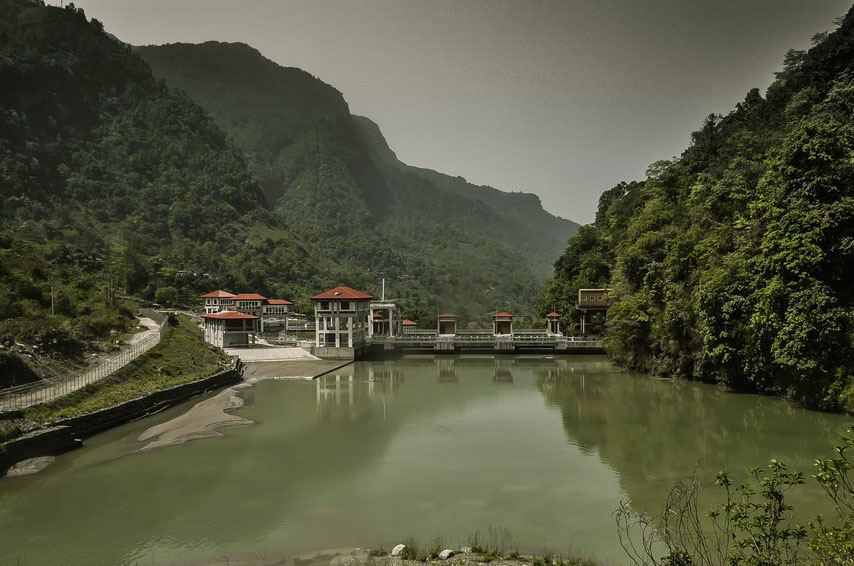
We took a local bus at 8:30 to go to Ngadi, which is en route to Manang (one of 100 beautiful places to see before you die), where the Shino-Sagarmatha Hydro Plant reservoir was. Quite a bumpy road it was! We drove past two new bridges, first over River Khudi and second over River Marshyangdi, built by Shino-Sagarmatha, followed by 4.2 meters long tunnel. Amazing!! This could be my first tunnel road and a rare to non-existent one in Nepal. We reached the Hydropower Plant reservoir, but the guard would not admit us in without a permit, so we walked 5 minutes further, crossing yet another bridge over the confluence of Marshyangdi and Ngadi rivers, and photographed the vicinity. Luckily, Ronish’s friend was driving from Manang, his Jeep, and we hitch-hiked to the School in Khudi and also requested a 30-second halt at the end of the tunnel for photography.
After briefing the Headmaster on the purpose of our upcoming medical camp at their school, we walked through a Gurung village, crossing a rather dilapidated wooden suspension bridge again over the River Marshyangdi instead of waiting for a local bus. After a half an hour walk in the 11 AM sun and breeze, I proposed a hitchhike approaching the Bolero Jeep. We all climbed the trunk of it and travelled standing for the rest of the way. I loved it. Riding a jeep through an eight-foot-wide turbulent road, constant jolting and jerking was an adventure itself.
We had to go to Rainas, a well-groomed Gurung settlement, after lunch. We grabbed our late meal and set out on a journey there, just to meet another bad luck. The vehicle that was supposed to pick us up from Paoudhi needed maintenance and was parked at the workshop. Sir advised us that we leave Besi Sahar immediately on a Dumre-route bus and get off at Poudhi to catch a 2:30 bus that took us to Rainas, where our home-stay was booked, and two more schools in the area to check out.
The Dumre bus was relaxed, and the Rainas bus was in a hurry. One had all the time in hand and waited for passengers while the latter one was patient less, didn’t wait an extra minute, and stranded us in the middle of Poudhi despite several requests.
Flustered with both the buses and not knowing what other options were, we met another soul who had met a similar fate of missing the same Rainas bus by 5 minutes. She was a local there and talked around and discovered the next bus to Rainas was leaving in 30 minutes. Glad we found someone who found us a ride. But our happiness didn’t last any longer, because other riders said the bus was scheduled to leave at 5:00 PM. God!! Both of us exhausted siblings got off the bus, bid adios to the Rainas plan there, and caught the first vehicle coming towards us for Dumre and then to Pokhara.
An online database of visual and written documentation on Nepal🇳🇵
Once you reach the highland of Tanchowk, you will breathe one of the most soothing airs in the world, with different plantations around you.
Sun Aug 09 2026
It was the prettiest house in Gorkha that was perched on a hill and served the most magnificent views of all the soaring peaks of Annapurna, Manaslu and Ganesh Himal.
Sun Aug 09 2026
Chant his name, offer your prayers, and pave the way for success, knowledge, and harmonious relationships under the watchful eye of Ganesh.
Sun Aug 09 2026
The coronation ceremony of King Birendra was one of the most lavishly done ceremony in the history of the Royal family of Nepal. VIPs from all over the world attended the coronation ceremony of King Birendra that happened on the 12-Falgun, 2031 BS
Sun Aug 09 2026
Oct 13, 2022
Jul 18, 2023
Sep 20, 2023
Jun 2, 2022


Ask Me About Nepal (AMAN) is your go-to digital platform for authentic, well-researched insights into Nepal’s people, places, culture, and hidden gems. From adventure to history, food to folklore—explore Nepal like never before!


Help us document the beauty and stories of Nepal. Your donation powers AMAN's journey.

Get captivating travel stories, hidden gems, and cultural insights from Nepal delivered to your inbox every month!
Want to Become a Contributor? Click Here
© 2025 Ask Me About Nepal. All Rights Reserved.